
Few emblems carry the weight of the north quite like the three interlocked triangles known today as the valknut. Whether etched into a memorial stone or worn quietly on a pendant, it is one of the very few genuinely Viking-age symbols still in wide use, rather than a modern invention dressed in old clothes. Yet the true valknut meaning is more elusive than most people assume, because no surviving Norse text ever names it or explains what it stood for. What we can say with confidence is bound up with Odin, with death in battle, and with the fate of those who fell.
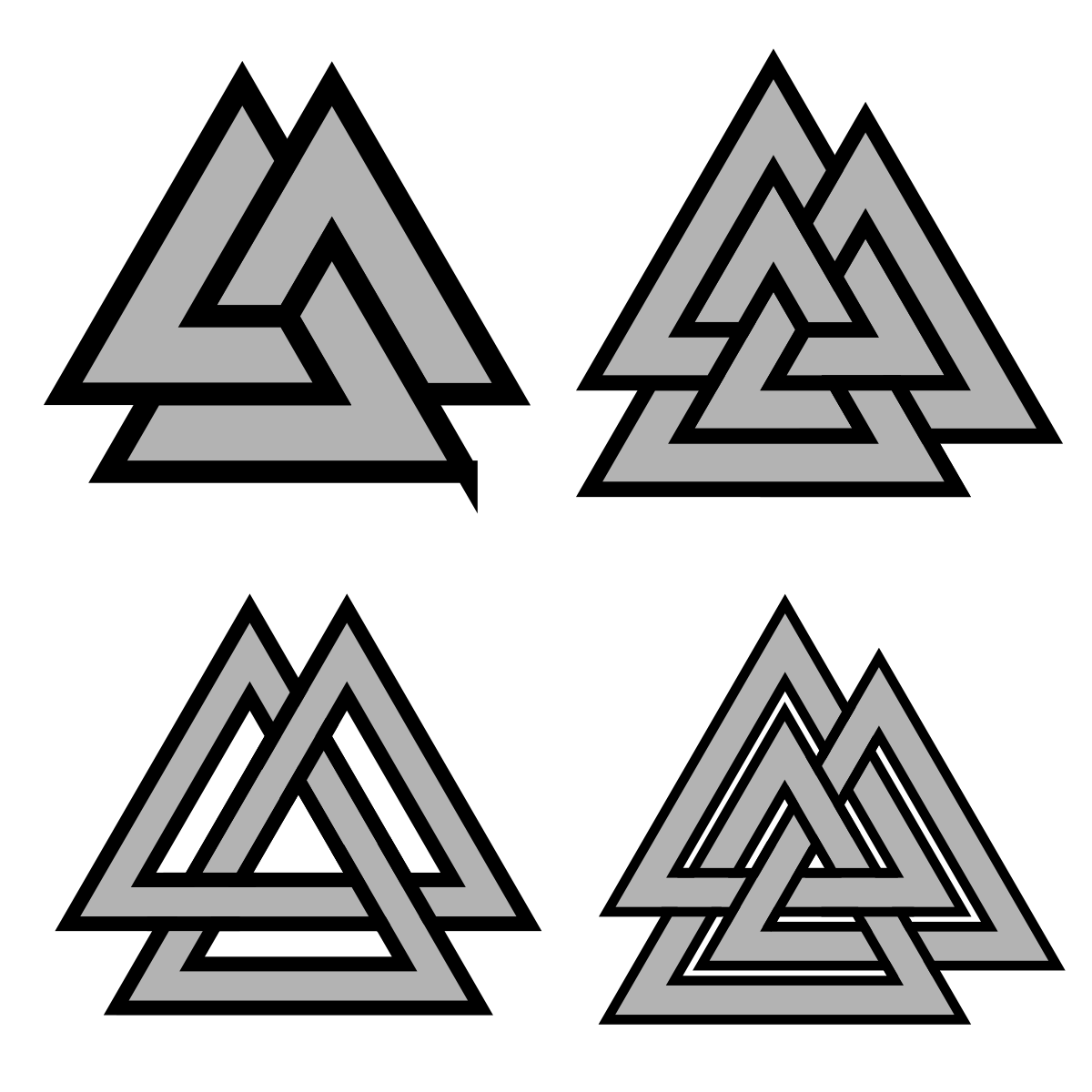
What Is the Valknut?
The valknut is a compact geometric device made of three triangles woven together into a single, balanced figure. It is deceptively simple to draw and instantly recognisable, which is part of why it has endured. Unlike many “Norse” symbols that circulate online, the valknut is attested on real objects from the Viking and Vendel periods, giving it a claim to authenticity that a great deal of pseudo-Viking iconography cannot match. It reads as ordered, deliberate and slightly severe, a knot that seems to lock something in place.
Where the Valknut Appears on Real Artifacts
The symbol turns up in a handful of significant places. The most famous is the Stora Hammars I picture stone on Gotland, where a valknut appears amid a dense scene of figures, weapons and what many read as ritual death. It is also carved into woodwork from the Oseberg ship burial in Norway, one of the richest graves the Viking world has left us, and it has been found stamped on some Anglo-Saxon cremation urns in England. Across these finds a pattern emerges: the valknut keeps company with Odin, with his ravens and horses, and with imagery of slaughter, sacrifice and the passage from life to death. That recurring context is the firmest ground we have.
Two Geometric Forms
Look closely and you will notice the valknut comes in two distinct constructions. The first is the unicursal form, drawn as a single continuous line that never lifts from the surface, closely related to the triquetra in its logic. The second is the tricursal or Borromean form, made of three separate triangles interlocked so that no two are actually linked on their own; remove any one and the whole arrangement falls apart. The Borromean version is the one most often seen on the stone carvings, and its “all or nothing” structure has invited plenty of symbolic speculation.
A Modern Name for an Ancient Sign
It is worth being clear that the word “valknut” is modern. It combines the Old Norse valr, meaning the slain warriors of the battlefield, with knut, meaning knot, and was coined only in the nineteenth and twentieth centuries as scholars and enthusiasts sought a convenient label. The Vikings themselves left us no recorded name for it. So while the term neatly captures the “knot of the slain” idea, we should remember it reflects later interpretation rather than a word anyone in the Viking age would have used.
What Did the Valknut Mean?
Two leading interpretations dominate serious discussion. The first casts the valknut as a sign of Odin’s power to bind and unbind the minds of warriors, granting the frenzy of battle-fury to some and fettering it in others, a fitting image for a god who governs both victory and defeat. The second sees it as Odin’s claim on those who die honourably in combat, marking them as bound for Valhalla. Supporting threads include the recurring number nine, deeply significant in Norse cosmology, and a line in Snorri Sturluson’s writing describing the heart of the giant Hrungnir as three-pointed, which some connect to the triangular motif.
Honesty matters here. Because no Norse source names or decodes the valknut, any single “official” meaning is ultimately educated guesswork. What is solid, and repeatedly borne out by the artifacts, is the association with Odin, with death in battle and with the afterlife. That is enough to make it powerful without pretending to a certainty the evidence cannot bear.
The Valknut Today
Like several Norse symbols, the valknut has on occasion been misappropriated by extremist groups, and it is worth acknowledging that plainly. For the overwhelming majority of people who wear it, though, it is nothing of the sort: it is a heritage symbol of resolve, courage in the face of mortality and remembrance of those who have gone before. Worn today it tends to be understated, a small pendant beneath a collar, a discreet embroidered mark or a clean printed motif, chosen for meaning rather than spectacle.
Wear it: The Heart of Odinism
Premium Norse-inspired apparel, made on demand.
🇺🇸 Fast US shipping · 🇪🇺 Ships across the EU · 🔒 Secure checkout
Sizing & shipping for US and EU
Every piece is printed on demand, so nothing sits in a warehouse waiting; it is made once you order. Garments run true to US sizing, so you can pick your usual size with confidence. For customers in Europe, we provide a full EU centimetre chart, measured across the chest and body length, so you can match your fit precisely before ordering. We ship to both the United States and the European Union, with tracking provided at dispatch.

 vikings


