
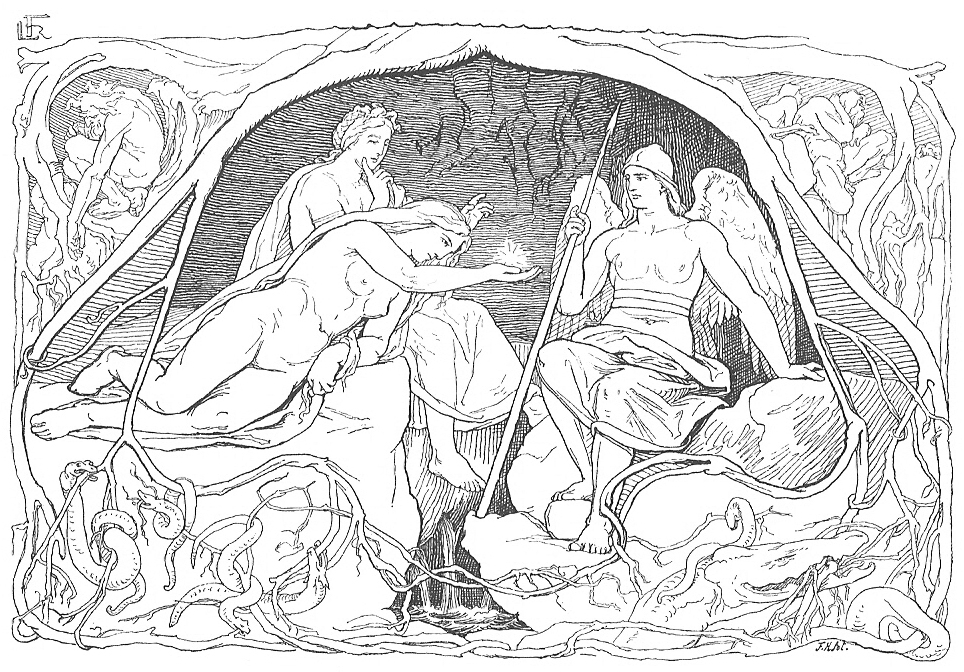
Beneath one of Yggdrasil’s three great roots sits a well so central to Norse cosmology that the gods themselves ride there to hold council every day. Here live the Norns of Norse mythology — Urd, Verdandi, and Skuld — three beings who don’t just predict fate, they tend it.
The Three Norns at the Well of Urd
Urðr (Urd), Verðandi, and Skuld live at the Well of Urd (Urðarbrunnr), beneath the root of Yggdrasil that stretches toward the realm of the gods. Their names translate roughly to “That Which Became,” “That Which Is Becoming,” and “That Which Should Become” — past, present, and a future that’s owed or bound to happen, rather than one that’s simply predicted.
Snorri Sturluson, writing in the Prose Edda, says the gods ride to this well daily to hold their court — it’s the closest thing Norse mythology has to a supreme judicial seat, and the Norns preside over it by default, simply by living there. Odin himself makes that ride along with the rest.
It’s easy to mix up the Well of Urd with Yggdrasil’s other famous water source, Mímir’s Well, which sits beneath a different root entirely, near Jötunheim, and is where Odin trades an eye for a drink of wisdom. Yggdrasil has three roots and three wells at its base — the Norns only preside over one of them, though it happens to be the one the gods themselves consider supreme.
The Norns at a glance
- Urd, Verdandi, and Skuld — past, present, and a future still owed
- Live at the Well of Urd (Urðarbrunnr) beneath a root of Yggdrasil
- Water and tend the World Tree daily to keep it from rotting
- Snorri also describes many lesser, unnamed norns who set the fate of individual people at birth
- Often compared to the Greek Moirai, though the traditions likely developed independently
Watering the World Tree
The Norns’ daily task is maintenance, not just prophecy. According to Gylfaginning, they draw water from the well along with the white clay that lies around it, and pour it over Yggdrasil’s branches so its roots won’t decay. Without that upkeep, the tree holding up all Nine Realms would simply rot.
It’s a detail that says something about how the Norse imagined fate itself: not a fixed thing set once and forgotten, but something that has to be tended, day after day, or the whole structure suffers for it.
Wear it: Viking Symbols
Premium Norse-inspired apparel, made on demand.
🇺🇸 Fast US shipping · 🇪🇺 Ships across the EU · 🔒 Secure checkout
Wyrd and Örlög: What “Fate” Meant to the Vikings
Old Norse has a specific word for the fate laid down at a person’s birth: örlög, sometimes translated as “primal law” or “that which is laid down before.” It’s related to the Old English concept of wyrd — the root of the modern word “weird” — and both describe fate less as a prediction and more as a foundation, something already woven into a life before it’s lived.
This wasn’t seen as bleak so much as clarifying. If your örlög is already set, the question worth asking isn’t “can I escape it” but “what will I do with the time I have.”
Fate vs Free Will — and Viking Courage
That question is exactly where Norse fatalism gets interesting. The sagas and eddic poems are full of people who know, or strongly suspect, how they’ll die — and act with more courage because of it, not less. Hávamál puts the idea plainly: cattle die, kinsmen die, and you yourself will die one day, but a good reputation, once earned, never dies.
If the outcome is already decided, the only thing left in your control is how you meet it. That belief is also part of why so many Viking-age protective symbols exist at all — people couldn’t out-argue fate, but they could still try to tilt the odds. Our guide to Norse runes for strength and protection covers exactly that impulse.
The Norns and the Greek Moirai: Parallel, Not Copy
It’s tempting to call the Norns “the Norse version of the Fates.” The Greek Moirai — Clotho, Lachesis, and Atropos — also number three, also govern birth and death, and are also frequently depicted spinning or measuring thread. Roman mythology has its own trio, the Parcae.
But there’s no solid evidence the Norse borrowed the idea directly from the Greeks or Romans. Three-fold fate goddesses turn up independently across several old Indo-European cultures, which is a more interesting story than straightforward copying — it suggests the image of fate as something spun, measured, and cut was already old long before either the Greeks or the Norse wrote it down.
Norns at Every Birth
The three great Norns aren’t the only ones. Snorri writes that many lesser norns exist too, coming from different origins — some descended from gods, some from elves, some from dwarves — and it’s these minor norns who show up at an individual’s birth to set their personal fate. A good norn gives someone a good life; a bad one doesn’t.
The Eddic poem Helgakviða Hundingsbana I shows this directly: norns arrive at the hero Helgi’s birth and spin the threads of his fate, tying golden cords to the sky and anchoring them east and west to mark the boundaries of the life he’ll live. It’s one of the few scenes in the mythology that shows the Norns actually at work, rather than just being discussed.
The saga of Norna-Gest gives an even sharper picture of what a norn’s judgment could mean day to day. At his birth, three norns visit; when the youngest feels slighted by the family, she spitefully declares the child will live only as long as a candle burning beside him stays lit. His mother snuffs it out at once and gives it to him for safekeeping. Norna-Gest carries that candle for centuries, outliving the Viking Age itself, until he finally lets it burn down — and dies the moment it goes out. It’s a story that treats a norn’s word as something closer to a binding contract than a vague prophecy.
Quick Answers
Who are the three Norns? Urd, Verdandi, and Skuld, who live at the Well of Urd beneath Yggdrasil and are associated with past, present, and an owed future.
Are the Norns the same as the Greek Fates? They’re similar in role and structure but not the same tradition — most treatments consider the resemblance a shared old motif rather than direct borrowing.
Do the Norns control every person’s fate, or just the gods’? Both. The three great Norns oversee cosmic order at Yggdrasil, while Snorri describes many lesser norns who set individual fates at each person’s birth.
What does “wyrd” mean in Norse belief? It’s the idea that fate (örlög in Old Norse) is laid down at birth rather than predicted moment to moment — a foundation you live out rather than a forecast you might dodge.

 History Warrior Team


