
For twelve centuries, one of Norway’s largest burial mounds kept its secret. Herlaugshaugen, a grass-covered giant more than 60 meters (about 200 feet) across on the island of Leka in Trondelag, has now been confirmed as Scandinavia’s oldest identified ship burial — and it was raised around AD 700, roughly a century before the Viking Age began. A study published in the journal Antiquity in June 2026 argues the find rewrites where the famous Viking ship-grave tradition actually came from.
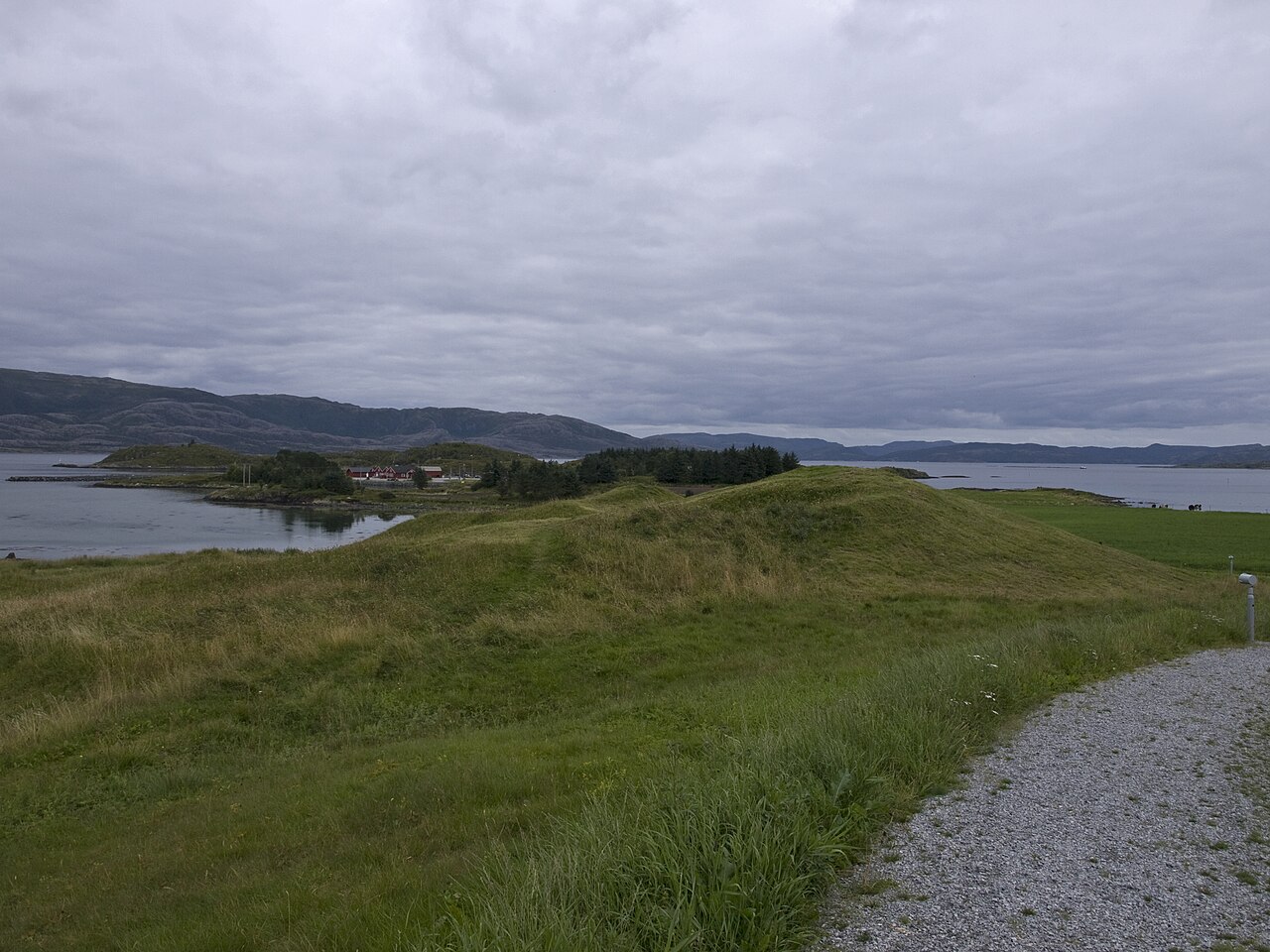
A mound with a legend: King Herlaug’s last stand
The mound has carried a story for centuries. According to the sagas, King Herlaug of Namdalen chose an extraordinary death in the late 800s: rather than submit to Harald Fairhair, the king who unified Norway, Herlaug reportedly walked into the mound with eleven of his men and had it sealed behind them.
Antiquarians dug into the mound three times in the 1750s and 1780s and claimed to find iron nails, a bronze kettle, animal bones — even a seated skeleton with a sword, long displayed as “King Herlaug” himself. Every one of those finds was lost, leaving nothing to verify. The new dating adds a twist worthy of the sagas: the mound is nearly two centuries older than Herlaug’s supposed era. Whoever was buried inside, it was not the king of the legend.
What the excavation actually found
In 2023, archaeologists from the NTNU University Museum, led by Geir Gronnesby, reopened the mound with modern methods. They recovered 29 large iron clinker nails — the tell-tale rivets of Norse shipbuilding, used to overlap hull planks — along with preserved wood fragments.
The nails’ size tells its own story. Spacing and dimensions point to a vessel more than 20 meters (about 65 feet) long: the same class as the celebrated Gokstad and Oseberg ships found in southern Norway — yet built generations earlier. Radiocarbon dating of the wood and charcoal shows the ship was built after AD 670, and the mound raised over it in the late seventh or early eighth century.
Wear it: Till Valhalla
Premium Norse-inspired apparel, made on demand.
🇺🇸 Fast US shipping · 🇪🇺 Ships across the EU · 🔒 Secure checkout
Older than the Viking Age itself
Historians conventionally open the Viking Age with the raid on Lindisfarne in AD 793. Herlaugshaugen predates that moment by about a century, placing it firmly in the Merovingian period (AD 550-800) — an era usually seen as the quiet prelude to the Viking explosion.
A 65-foot ship is not a fishing boat. Building one demanded specialist shipwrights, huge quantities of timber and iron, and a community able to feed and organize them — then bury the whole vessel underground as a statement of power. That means coastal societies in northern Norway commanded serious maritime resources long before the first Viking sails appeared off England, likely built on wealth from northern trade in furs, down and fish along the Namdalen coast.
From Sutton Hoo to Oseberg: one North Sea tradition
The date matters far beyond Norway. Europe’s most famous early ship burial, Sutton Hoo in England, dates to about AD 630; Norway’s great Viking ship graves at Oseberg (AD 834) and Gokstad (c. AD 900) came two to three centuries later. Herlaugshaugen lands almost exactly in the gap.
The Antiquity authors argue this closes the chronological space between the Anglo-Saxon and Scandinavian traditions, revealing one continuous ship-burial culture spanning the North Sea — an idea shared among connected maritime elites, not a Viking invention. As archaeologist Howard Williams of the University of Chester put it: “It’s a myth that these elaborate ship burials belong only to the Viking Age.”
Why Herlaugshaugen rewrites the story
Three takeaways from the study:
- Ship burials are older than the Vikings. The grandest Norse funeral rite was inherited from the Merovingian world, then perfected in the Viking Age.
- Northern Norway was a power center early. Monumental mounds and 20-meter ships put Trondelag’s coast on the political map a century “ahead of schedule.”
- The sagas preserve places, not dates. Herlaug’s legend attached itself to a mound already ancient when he lived — much as folklore gathered around the record Viking coin hoard site in Norway found earlier this year.
The full research is published in Antiquity, with coverage by National Geographic and HeritageDaily.
A king who may never have been there, a ship no one knew existed, and a burial rite older than the age that made it famous. Somewhere under the grass of Leka, the prow of Scandinavia’s first known funeral ship still points toward the sea — a fitting image of the honor culture behind the phrase “Til Valhalla”.

 vikings


