
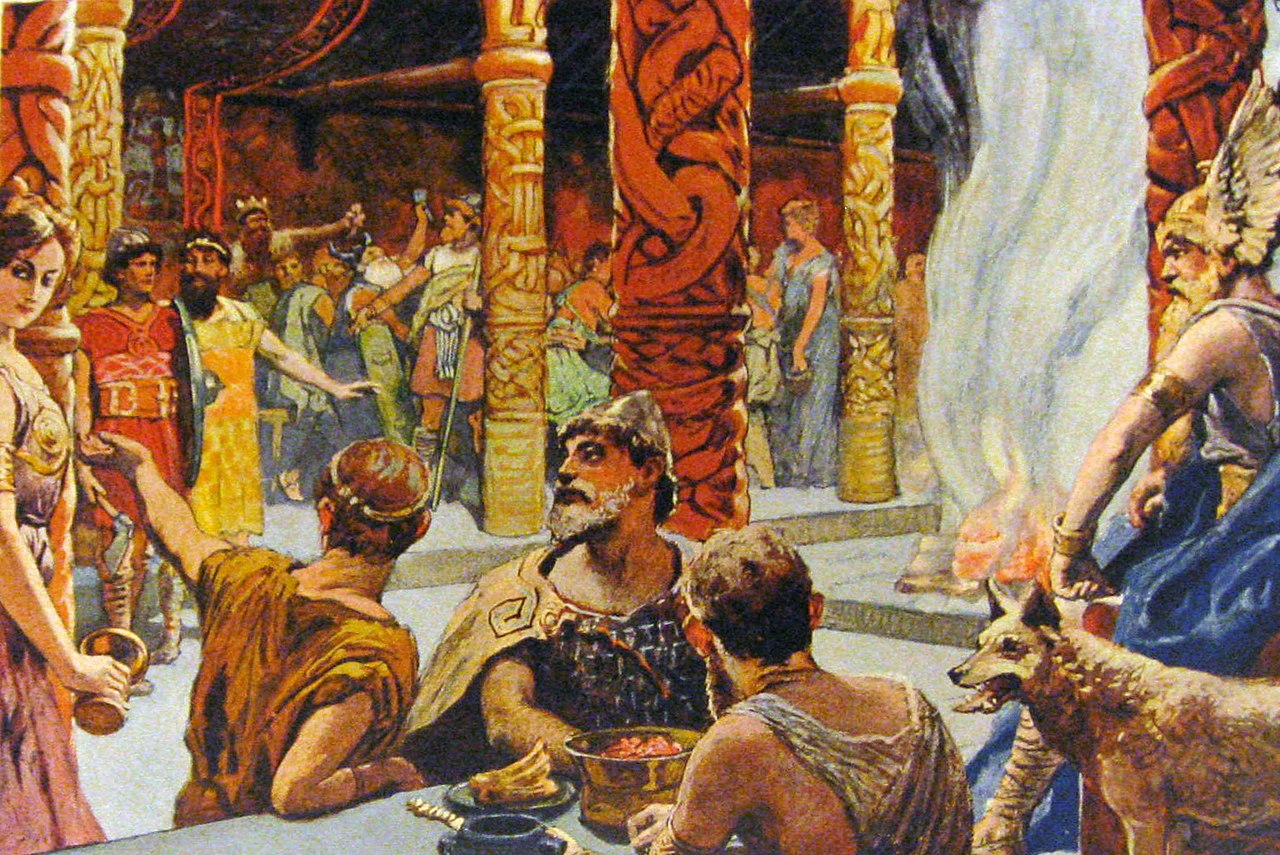
Valhalla meaning, in one line: it’s Odin’s hall for half of the warriors who die in battle, built for one purpose — stockpiling fighters for Ragnarok. The Old Norse Valhöll literally means “hall of the slain,” and the Poetic Edda describes it in specific, almost architectural detail: 540 doors, a roof of shields, spears for rafters.
Valhalla by the Numbers: What Grímnismál Actually Describes
The name itself breaks down as plainly as valkyrja does. Old Norse valr means “the slain in battle,” and höll means “hall.” Valhöll is, literally, “hall of the slain” — no metaphor required.
The poem Grímnismál gives Valhalla oddly precise measurements for a mythical building. It has 540 doors, and through each one 800 warriors can march abreast when Ragnarok finally starts — 432,000 men pouring out at once, by the poem’s own arithmetic. The roof is thatched with shields, the rafters are spears, a wolf hangs over the western door, and an eagle hovers above it. None of this is decorative flourish; it’s a war-hall built entirely from the trappings of war, down to the building materials.
Snorri Sturluson expands on this in the Prose Edda, adding that the hall sits in Asgard and that its walls gleam like gold — a detail that later fed into the German name Walhall used in Wagner’s operas and, eventually, the English “Valhalla” most people recognize today.
Getting there isn’t automatic even for the chosen dead. The Prose Edda places Valhalla in Asgard, reachable via the burning rainbow bridge Bifrost, guarded day and night by the watchman god Heimdall so nothing hostile can cross into the gods’ realm.
Wear it: Till Valhalla
Premium Norse-inspired apparel, made on demand.
🇺🇸 Fast US shipping · 🇪🇺 Ships across the EU · 🔒 Secure checkout
The Einherjar: Dying in Practice Every Day
The warriors who live in Valhalla are called the einherjar, and their routine is built entirely around war. Every morning they arm themselves and fight each other in the courtyard, cutting each other down in earnest. Every evening, whatever wounds and deaths they suffered heal completely, and they walk back inside to eat and drink together as friends. It’s not a punishment — it’s training. Snorri is explicit that this cycle exists so the einherjar stay sharp for the one battle that actually matters.
This detail reframes what “going to Valhalla” meant to a Viking Age audience. It wasn’t eternal rest. It was eternal preparation for a war they were destined to lose.
Sæhrímnir and Heidrun: An Endless Feast
Feeding hundreds of thousands of warriors takes some mythological engineering. Grímnismál solves it with a boar named Sæhrímnir, cooked by the cook Andhrímnir in a cauldron called Eldhrímnir. Every night he’s slaughtered and eaten, and every morning he’s whole again, ready for the next meal. Snorri even notes there’s rarely enough Sæhrímnir to go around, given how many einherjar there are.
Drink comes from a goat named Heidrun, who stands on the roof of Valhalla eating leaves from a tree usually identified with the world tree, and produces an endless stream of mead from her udder instead of milk — enough to fill a vat large enough for every warrior in the hall.
Who Actually Gets In: Odin, Freyja, and Everyone Else
Here’s the detail most retellings skip: Odin doesn’t get every warrior who dies in battle. Grímnismál says Freyja chooses first, taking half the slain to her field Fólkvangr, and Odin gets the other half for Valhalla. The valkyries carry out that division on the battlefield itself.
And that’s only for people who die fighting. Most people in Viking Age Scandinavia didn’t die in combat — they died of illness, old age, or accident, and the sources are fairly consistent that those deaths sent you to Hel’s realm instead, a much less glamorous afterlife ruled by Loki’s daughter. Valhalla was never meant to be everyone’s destination. It was a recruitment hall for a specific army.
The choosing itself could be unsettling. In the Völsunga Saga, Odin appears on the battlefield during King Sigmund’s final fight and shatters his sword with a spear-thrust, causing the fatal wound himself. It’s framed less as betrayal than as Odin claiming a warrior he wants for Valhalla — a reminder that being chosen wasn’t always a reward for winning. Sometimes the hall’s recruiter simply decided your fight was over.
Valhalla’s Real Purpose: Stockpiling for Ragnarok
Every detail in the myth points back to one event. Odin isn’t collecting warriors out of generosity or love of a good feast — he’s building an army because prophecy tells him he’ll need every fighter he can get when Ragnarok arrives. The wolf Fenrir breaks free, the sea serpent Jörmungandr comes ashore, and the einherjar march out through those 540 doors to fight beside the gods in a battle most of them, including Odin himself, don’t survive.
That’s the tragic engine under the whole myth. Valhalla is glorious on the surface — endless mead, endless combat, endless camaraderie — but its entire purpose is preparation for a war everyone involved already knows they’re going to lose.
“Til Valhalla”: How a Norse Hall Became a Modern Phrase
The phrase “Til Valhalla” — “to Valhalla” — has become shorthand in modern military and veteran communities for honoring someone who died with honor, and it shows up constantly in tattoos, memorial posts, and apparel. We’ve traced exactly where that phrase comes from and how it picked up its current meaning in a dedicated piece on the Til Valhalla phrase, worth reading if you’ve seen it without knowing the backstory.
It’s a fitting afterlife for the myth. A hall built for warriors preparing for one last fight became a phrase used by people who understand exactly what that kind of preparation and loss feels like — the same reverence for a warrior’s death that shows up in how differently the axe and sword carried symbolic weight for Viking Age fighters too.
Quick Answers
What does Valhalla mean? Valhalla (Old Norse Valhöll) means “hall of the slain” — Odin’s hall in Asgard where half of the warriors killed in battle go to prepare for Ragnarok.
How many doors does Valhalla have? Grímnismál gives it 540 doors, each wide enough for 800 warriors to march through side by side.
Does everyone who dies go to Valhalla? No. Only about half of battle-dead go there, since Freyja takes the other half to Fólkvangr; people who die of illness or old age go to Hel instead.
What do warriors do in Valhalla every day? The einherjar fight each other to the death every morning, then rise fully healed each evening to feast — training that never ends until Ragnarok.

 History Warrior Team


