
The Jarl’s Blueprint: Planning Your Seafaring Legend
Before the first axe falls, before a single shaving of oak touches the workshop floor, the longship is born in the mind. To build a vessel worthy of the sagas is to first become a scholar and a planner. This is not a weekend project; it is a legacy. The path begins not with timber, but with history. Immerse yourself in the ghosts of longships past. Study the breathtaking archaeological finds—the Oseberg ship with its intricate carvings, the formidable Gokstad ship built for the high seas, and the Skuldelev wrecks that reveal the diversity of Norse naval power. These are your true blueprints, preserved in the earth for a millennium.
You must decide what kind of saga you wish to write. Are you building a fearsome Drakkar, a dragon-headed warship designed for speed and terror? Or perhaps a smaller, more nimble Snekkja for raiding parties and coastal exploration? Maybe your ambition lies with the Knarr, the deep-bellied, reliable merchant ship that carried Vikings to Iceland, Greenland, and beyond. Your choice will dictate the scale, materials, and complexity of your undertaking.
Once your vision is clear, you must gather the lifeblood of the ship: the wood. The Vikings did not simply use any timber; they understood the soul of each tree. For the ship’s backbone, the keel, and its strong ribs, nothing but oak will suffice. Its dense, interlocking grain provides immense strength and natural resistance to rot. For the hull planks, or strakes, you will need a more flexible wood. Old-growth pine or larch is ideal, as it can be coaxed into the ship’s elegant curves. And for the oars that will bite into the sea, strong and straight-grained ash is the traditional choice. Sourcing this timber is a quest in itself. Seek out green, unseasoned wood, for it is far more forgiving to bend and shape than kiln-dried lumber.
Your armory of tools will be a blend of the ancient and the modern. While a Viking shipwright worked with a side axe, an adze, spoon bits, and a drawknife, the modern craftsman can wisely supplement these with a bandsaw for rough cuts and a power drill for starting holes. Do not mistake this for a shortcut. The soul of the work, the fine shaping and fitting of each piece, will still come from the skill in your hands and the keenness of your eye. You will also need to set up a steam box—a long, insulated chamber where you can heat the planks to make them pliable enough to bend into the serpent’s form.
Forging the Beast: The Art of Clinker Construction
With your plans laid and materials gathered, the true labor begins. The first piece to be laid is the most crucial: the keel. This is the spine of your sea-serpent, a single, massive piece of T-shaped oak that will define the ship’s length and character. The stem and stern posts are meticulously joined to the keel using complex, interlocking scarf joints, creating a seamless and powerful foundation upon which the entire vessel will rise.
Now comes the magic of Norse shipbuilding: clinker construction, also known as lapstrake. Unlike modern boats built around a frame, a longship is built from the outside in, its shell created first. Starting from the keel, you will shape and fit each plank, or strake, one by one. Each new strake overlaps the one below it by an inch or two, creating a distinctive and incredibly strong hull. This is where your steam box becomes essential. Long planks of pine are heated until they are as malleable as leather, then quickly bent into place and clamped, following the graceful, sweeping lines of the hull. It is a slow, rhythmic process, a dance between wood, steam, and human will.
The overlapping strakes are not held together by glue, but by the iron will of the Viking age: rivets. You will need thousands of them. A true craftsman might even forge their own from raw iron stock. The process, known as clench-nailing, is a two-person job. From the outside, a long iron rivet is driven through a drilled hole in the overlapping planks. On the inside, a helper places a small, square iron washer called a ‘rove’ over the rivet’s tip. The excess length is snipped off, and then, with hammer against dolly, the end of the rivet is peened over, creating a second head. This clenches the planks together, forming a bond that is immensely strong yet flexible, allowing the ship to twist and flex with the motion of the waves rather than shattering against them.
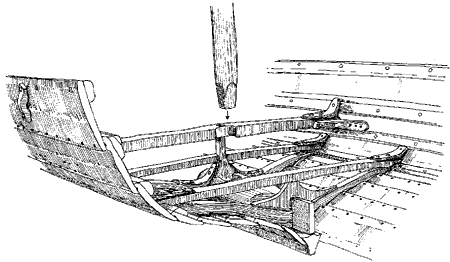
Only when the hull is a complete, hollow shell do you build the skeleton within. The ribs, or frame timbers, are carefully shaped to fit the hull’s internal curves. In a remarkable feat of engineering, the Vikings did not nail the ribs directly to the planks. Instead, they carved raised cleats, or bosses, on the inside of the strakes and lashed the ribs to them using tough, flexible cordage made from spruce or linden root. This ingenious method is the secret to the longship’s legendary resilience, allowing the entire structure to move as one living entity upon the violent sea.
Carving the Soul: Dragon Prows, Shields, and Sails
A hull, no matter how perfectly built, is just a vessel. To give it a soul, to transform it into a true longship, you must bestow upon it the symbols of Norse power and identity. The most iconic of these is the prow. Whether it’s a fearsome, gaping dragon or a coiled serpent, the prow head was the ship’s face to the world. It was a masterpiece of the carver’s art, designed to inspire terror in the hearts of enemies and awe in the eyes of allies. Historically, these figureheads were often removable. A ship approaching a friendly port would lower its dragon head as a sign of peace, so as not to frighten the local land spirits (landvættir).

Next, you must craft the gunwale, or shield-rail. This is where the crew’s shields would hang, creating a vibrant, intimidating wall of color and steel along the ship’s sides. This served a dual purpose: it kept the shields ready for battle while offering the oarsmen a small degree of protection from arrows and spray. Each shield, painted with a warrior’s personal device, added to the ship’s fearsome reputation.
Finally, you must harness the wind. A Viking longship was a hybrid, capable of being propelled by both oar and sail. The mast, a single tall pine trunk, was stepped amidships in a massive block of oak called the ‘kerling’ (old woman). It was designed to be raised and lowered quickly, even at sea. The sail itself was a prized possession, a vast square of woven wool. Creating a historically accurate sail is a monumental task in itself. The wool must be thick and lanolin-rich, then likely treated with a mixture of horse-grease, tallow, or fish oils to make it more water-resistant and less porous. Rigging this great square sail with its yardarm, ropes, and the ‘beitiáss’—a unique spar used to stiffen the leading edge of the sail when sailing against the wind—is the final step in commanding the power of the elements.
With the last rope tied and the final shield hung, your work is done. You have not simply built a boat; you have resurrected a piece of history. You have poured sweat, blood, and spirit into wood and iron, following the same steps as your ancestors. To stand at the steerboard of a longship you have built with your own hands is to feel the heartbeat of a thousand years of exploration, trade, and conquest. It is a monument to craftsmanship, a testament to endurance, and a saga written not in ink, but in oak.

 vikings


