
The great ships and their silent kings
Along the deep, mist-shrouded fjords of Scandinavia, the earth holds secrets. Beneath grassy mounds that rise like sleeping giants against the skyline lie the remnants of a world forged by fire and ice—the world of the Vikings. More than just graves, these are the final, silent throne rooms of forgotten kings and queens, rulers whose names may be lost to sagas but whose power is immortalized by the treasures buried with them. The most magnificent of these treasures are not crafted from silver or gold, but from oak and iron: the great longships.
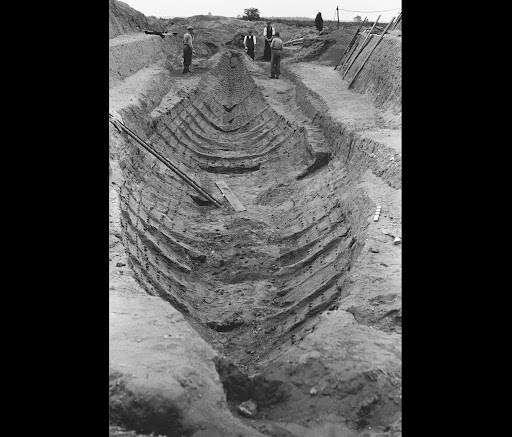
A Viking king was inseparable from his ship. It was his vessel of conquest, his tool of trade, and the symbol of his reach across the unforgiving northern seas. It was only fitting, then, that it should become his tomb, a worthy vessel to carry his spirit to the halls of Valhalla. The practice of ship burial was reserved for the highest echelons of Norse society, an extravagant and profound statement of status that required immense resources and community effort. These were not mere funerals; they were foundational events, cementing a dynasty’s legacy in the very soil of their homeland.
Archaeology has pulled back the curtain on these incredible rites, most famously with the discoveries of the Gokstad and Oseberg ships in Norway. The Gokstad ship, a swift and formidable vessel built for war, was the final resting place of a powerful chieftain in the 9th century. Buried with him were not only his weapons but also twelve horses, six dogs, and even a peacock, all sacrificed to serve him in the afterlife. The sheer scale of the burial goods speaks to a ruler of immense authority, a man who commanded loyalty not just from his warriors, but from the natural and spiritual worlds he sought to dominate.
Even more breathtaking is the Oseberg ship. An ornately carved vessel of unparalleled artistry, it housed the remains of two women, believed to be a queen or high-priestess and her attendant. The craftsmanship of the ship itself, with its intricate animal-head post and spiraling carvings, is a masterpiece of the Viking Age. The chamber was filled with a stunning array of artifacts: exquisitely carved wooden sleds, a wagon, beds, tapestries woven with scenes of legend, and chests filled with personal belongings. The Oseberg burial provides a rare glimpse into the opulent, ceremonial, and spiritual life of a Norse court, revealing that power was not solely wielded by warriors, but also by women of immense spiritual and political influence. These ships, now resting in museums, are more than relics; they are time capsules, carrying the silent sagas of the kings and queens who sailed them into legend.
The soul of the warrior: Royal blades and battle gear
While a ship carried a king’s body to the next world, it was his sword that carried his soul through this one. In Norse culture, the sword was the ultimate symbol of a warrior’s identity, an extension of his arm and his will. For a king, it was infinitely more. It was a scepter of power, an heirloom of his lineage, and a masterpiece of metallurgical art. The finest swords were given names—like Leg-biter or Foe-reaper—and were believed to possess a spirit of their own, their histories recounted in skaldic poetry alongside the deeds of the heroes who wielded them.

The blades of forgotten kings were not common weapons. They were forged using a complex and laborious technique known as pattern-welding, where rods of iron and steel were twisted and hammered together to create a blade of incredible strength, flexibility, and beauty. The rippling, watery patterns on the surface were the signature of a master smith, a sign of quality that would be immediately recognized on the battlefield. The hilt was where the king’s wealth was truly displayed. Guards and pommels were often cast in bronze or silver, intricately decorated with knotwork and inlaid with precious metals and gemstones. To hold such a weapon was to hold a concentration of power, craftsmanship, and authority.
Among the most legendary of these are the Ulfberht swords, a group of about 170 blades found across Europe. Inscribed with the maker’s mark, +VLFBERH+T, these swords were made of crucible steel so pure it was not seen again in Europe for nearly a thousand years. The technology required to produce such a weapon was astonishing, leading many to believe they were reserved exclusively for Viking nobility and the wealthiest chieftains. Owning an Ulfberht sword was a definitive statement of elite status. It meant a king could afford not just the best weapon, but a weapon that seemed to defy the limits of its time.
But a king’s battle-readiness was not defined by his sword alone. His entire panoply of gear was designed to protect him and project his royal authority. The Gjermundbu helmet, the only complete Viking helmet ever found, with its intimidating “spectacle” guard, shows a fusion of practicality and presence. A king’s shield would be brightly painted with symbols of his clan, and his byrnie, a coat of chainmail, was worth a fortune, painstakingly assembled from thousands of interlocking iron rings. In the chaos of a shield wall, a king had to be instantly recognizable—a shining beacon for his men and a terrifying omen for his enemies. His gear was his crown on the battlefield, each piece a relic forged not only to win wars but to build a legacy that would echo long after his final battle was fought.
The hoard of a ring-giver: Power in silver and gold
A Viking king’s power was measured in two ways: by the enemies he defeated and by the followers he kept loyal. While his sword accomplished the former, it was his treasure hoard that secured the latter. In the sagas, one of the most common kennings, or poetic descriptions, for a good king is “ring-giver.” This title was literal. A king’s wealth was not meant to be locked away in a vault; it was a flowing river of silver and gold, used to reward fealty, secure alliances, and display his prosperity to the world.
Viking jewelry was far more than simple adornment. It was a wearable bank account and a public declaration of one’s place in the social hierarchy. The most common form of this wealth was the arm ring. These heavy bands of twisted or plaited silver were often left open-ended, allowing them to be adjusted to fit. More importantly, they could be easily cut into smaller pieces, a practice known as creating “hack-silver,” to be used as currency in transactions. A king would literally break off a piece of his own wealth to pay a loyal warrior or a skilled artisan, a powerful and personal gesture of patronage. These rings, worn proudly on the arms of a king’s hird (his personal retinue), were a visible mark of their bond to their leader.
Massive hoards discovered by archaeologists reveal the staggering scale of this wealth. The Cuerdale Hoard, found in England, contained over 8,600 items, including more than 7,000 coins and a mass of silver ingots, jewelry, and hack-silver weighing over 40 kilograms. This treasure trove contained coins not just from Viking territories but from the Carolingian Empire and the Islamic Caliphates, showcasing the incredible global network of Viking trade and raiding. These hoards tell the story of kings who were not just pirates, but savvy political and economic players on the world stage.
The craftsmanship of royal jewelry speaks volumes about the culture that created it. Intricate silver filigree brooches, used to fasten a cloak at the shoulder, were often shaped in the gripping beast style, a chaotic and beautiful tangle of animals and serpents that symbolized the powerful forces of the cosmos. Heavy gold torcs, worn around the neck, were the ultimate status symbol, reserved for only the most powerful kings and jarls. These pieces were not just beautiful; they were imbued with meaning, their designs echoing the myths and beliefs that held the Norse world together. When we look at the gleaming silver and gold from a Viking hoard, we are not just seeing treasure. We are seeing the tools of diplomacy, the price of loyalty, and the glittering, tangible evidence of a king’s power to give—and to take away.

 vikings


