
A shadow on the horizon
Imagine the scene. You stand on a windswept shore in 9th-century England, the air thick with the smell of salt and fear. On the horizon, the sleek, menacing silhouettes of longships cut through the grey waves. At the prow of the lead ship, something snaps and unfurls in the wind. It is not a king’s pennant or a simple sailcloth. It is a banner, dark and triangular, and at its heart is the unmistakable shape of a black bird in flight. It is the Hrafnsmerki. The raven banner.
For the peoples of Europe, this was a sight that heralded slaughter, plunder, and the coming of the Northmen. For the Vikings themselves, it was far more than a flag. It was a sacred relic, a psychological weapon, and a direct line to the gods. It was a symbol of Odin’s favor, a promise of victory woven into a simple piece of cloth. This is the story of the raven banner, a legendary artifact that flew at the head of Viking armies, leaving a legacy of terror and awe in its wake.
The raven’s shadow: a symbol steeped in Norse belief
To understand the power of the raven banner, we must first understand the power of the raven in the Norse world. This was no common bird. It was a creature of immense spiritual significance, intrinsically linked to the highest and most fearsome of the Æsir: Odin, the Allfather.
Odin’s eyes and mind
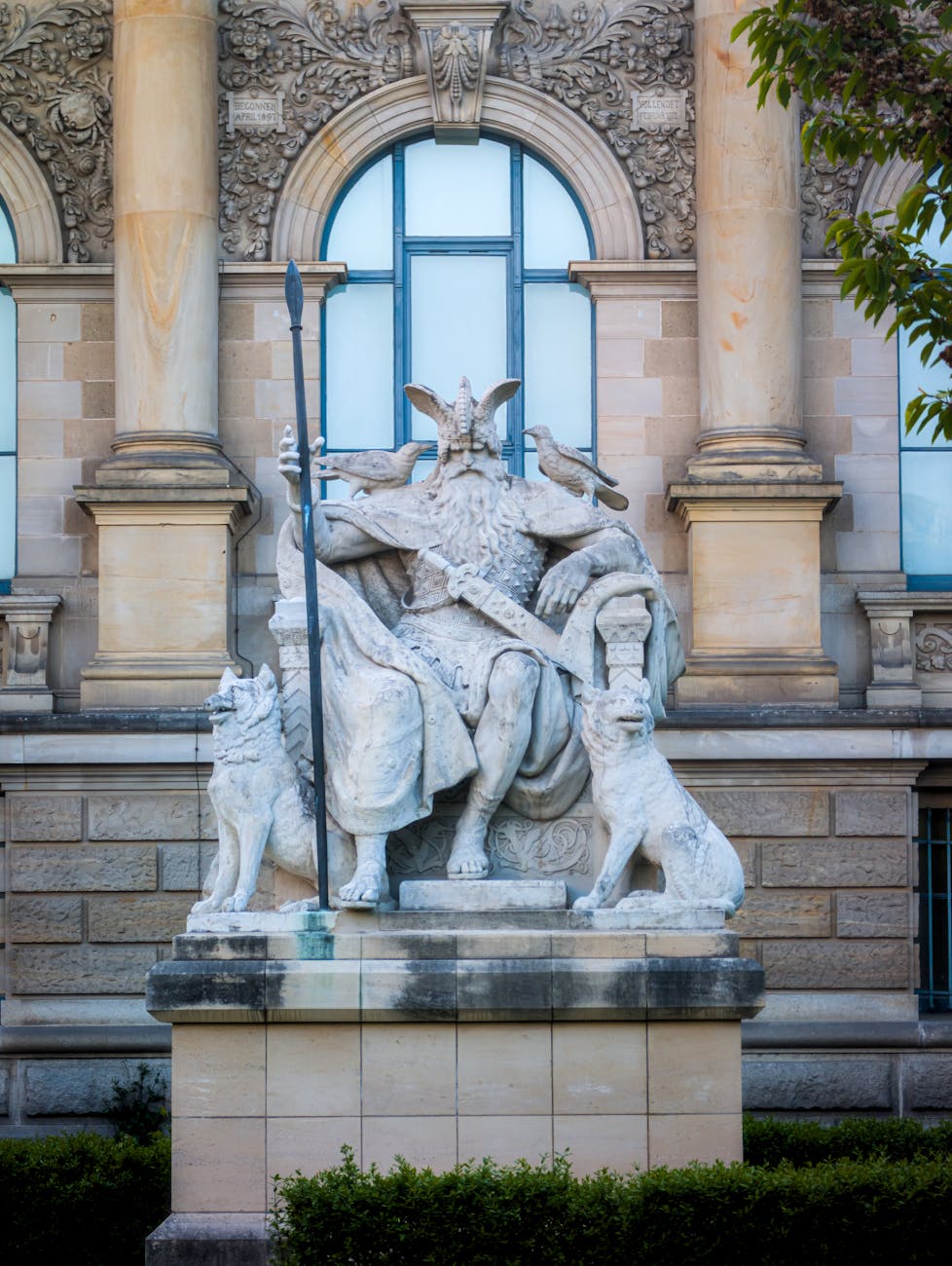
Perched on Odin’s shoulders were his two loyal raven companions, Huginn (thought) and Muninn (memory). Each dawn, he would send them out to fly across the nine realms, and each evening, they would return to whisper all they had seen and heard into his ear. They were his spies, his messengers, and his intellect. Through them, Odin was all-seeing and all-knowing. A Viking warrior, seeing a raven circle overhead, might see it not as a mere animal, but as a watchful eye of the Allfather himself, a sign that the gods were present and taking notice of their deeds.
Harbingers of battle’s feast
The raven’s connection to war was even more visceral. As natural scavengers, ravens and other corvids were a common sight on the aftermath of any battlefield, feasting on the fallen. In Norse poetry, they are called the “hawks of blood” and the “gulls of the corpse-sea.” This grim association was flipped on its head by the Vikings. The presence of ravens wasn’t just a sign of death; it was an omen of a coming victory. A great battle meant a great feast for the ravens. Therefore, to fly a raven banner was to make a bold declaration: “We are here to create a feast for Odin’s birds. We are here to win.” It was a promise of glorious slaughter, a tribute offered to the god of war and death.
Woven by fate: the legendary origins of the Hrafnsmerki
Like many Viking relics, the origins of the raven banner are shrouded in myth and saga, its threads intertwined with the lives of the most legendary figures of the age. While several Norse leaders flew raven banners, the most famous story ties its creation directly to the great Viking hero, Ragnar Lothbrok.

The legend, as told in the sagas, claims that the first and most powerful raven banner was woven by Ragnar’s daughters. Upon learning of their father’s execution—thrown into a pit of snakes by King Ælla of Northumbria—they crafted the magical standard for their brothers, Ivar the Boneless, Ubba, and Halfdan. It was a tool of vengeance, imbued with the sisters’ seiðr (Norse magic) to guide the Great Heathen Army in its invasion of England.
This banner was said to possess a supernatural quality. It was a tool of divination on the battlefield. When carried into battle, if the raven woven upon it appeared to flap its wings, victory was assured for the sons of Ragnar. But if the raven hung limp and motionless, it was a dire omen of defeat. This belief transformed the banner from a simple standard into an active participant in the battle—an arbiter of fate that could fill warriors with unshakeable courage or chilling dread.
Under the banner’s flight: historical accounts of a feared standard
While its origins lie in legend, the raven banner is no mere fantasy. It appears in numerous historical and semi-historical accounts, particularly in the chronicles written by those who faced it in battle.
The Great Heathen Army in England
The Anglo-Saxon Chronicle, a primary source for the period, makes mention of the Viking banner during the campaigns of the 9th century. One famous account describes the Battle of Cynwit in 878. A Viking force led by Ubba, one of Ragnar’s sons, besieged a stronghold in Devon. The chronicler notes with a mix of fear and fascination that the Vikings carried with them a banner called the “Hrefn,” or Raven.
Despite the banner’s supposed power, this battle ended in a disastrous defeat for the Vikings. The Saxon forces launched a surprise attack, killing Ubba and capturing the Hrafnsmerki. For the Saxons, capturing the banner was a monumental victory, not just militarily but symbolically. It was proof that the pagan magic of the Northmen could be broken by Christian faith and English steel.
The tragic pact of Sigurd the Stout
Perhaps the most poignant tale of the raven banner comes from the Orkneyinga Saga, which tells the story of Sigurd the Stout, the Earl of Orkney, at the turn of the 11th century. His mother, a powerful völva (sorceress), wove him a raven banner with her potent magic. She presented it to him with a grim prophecy: “This banner will bring victory to the man it is carried before, but death to the man who carries it.”
For years, the prophecy held true. Sigurd was victorious in his campaigns, but each of his standard-bearers fell in battle. The banner became both a blessing and a curse. At the fateful Battle of Clontarf in 1014, after three of his standard-bearers had been killed, Sigurd was urged to appoint another. In a moment of fatalistic despair, he supposedly declared that it was his turn to “bear the devil himself.” Tucking the banner under his own cloak, he plunged back into the fray and was swiftly cut down. The army that followed him was victorious, but as foretold, the banner had claimed its carrier.
Unraveling the threads: what did the raven banner look like?
Frustratingly for historians and enthusiasts, not a single raven banner has ever been recovered from an archaeological dig. They were made of silk and linen, materials that rarely survive a thousand years in the soil. Everything we know about its appearance is pieced together from written descriptions and artistic depictions.
Clues from coins and chronicles
Written accounts, like the Annals of St. Neots, describe the banner as being made of pure white silk, with the raven itself woven into the fabric. Others suggest a darker, more practical material. The most common description is of a triangular flag, not unlike the wind-vanes that flew from the masts of longships, often with a series of tassels or streamers attached to the outer edge that would have looked like the bird’s feathers in the wind.
Some of our best visual evidence comes from Norse-Gaelic coinage minted in Northumbria in the 10th century. Coins struck by leaders like Olaf Sihtricsson clearly depict a triangular banner with a raven symbol at its center. This numismatic evidence confirms that the banner was a real and recognizable symbol of Viking power in England.
A symbol of power
The design was likely simple but unmistakable—a stylized black raven, perhaps in profile, with its beak open and wings outstretched. The simplicity was key. On a chaotic battlefield, shrouded in the smoke and dust of combat, the banner needed to be immediately identifiable, a rallying point for warriors and an icon of terror for their foes.
The legacy of the raven
The raven banner was so much more than a piece of cloth. It was a declaration of identity, a vessel of faith, and a masterpiece of psychological warfare. For a Viking warrior, to march under its shadow was to march with the blessing of Odin. It was a tangible connection to the divine, a belief that their fate was being actively shaped by the gods of war. For their enemies, it was the embodiment of the pagan fury that descended upon them from the sea, a symbol as terrifying as the dragon-prowed longships themselves.
Today, the raven continues to be a potent symbol of the North. It represents wisdom, war, and the wild, untamed spirit of the Viking Age. While the original Hrafnsmerki may be lost to time, its story endures—a reminder that in the fierce world of the Vikings, even a simple thread could be woven with enough magic, belief, and blood to change the course of history.

 vikings


