
Mjölnir’s echo: the symbolism of Thor in Norse metalwork
In the echoes of the North, where thunder rolls across fjords and lightning splits the sky, one name reverberates with unmatched power: Thor. He was not a distant, ethereal god for kings and jarls alone; he was the champion of the common folk, the protector of Midgard, the embodiment of raw, unyielding strength. His legacy wasn’t just told in sagas whispered around the longhouse fire; it was a tangible force, hammered into the very steel that defined the Viking Age. This is the bloodline of Thor—a spiritual inheritance of might, woven into every arm ring, axe head, and pendant.
The most iconic symbol of this divine connection is, without question, Mjölnir. The hammer of Thor was more than a weapon capable of leveling mountains; it was a sacred tool of consecration, protection, and blessing. To wear a Mjölnir pendant was to carry a piece of the Thunder God’s power. Archaeological sites across the Viking world, from the icy shores of Iceland to the river routes of the Rus, are rich with these hammer amulets. They were crafted from humble iron, precious silver, and even amber, signifying that this symbol of strength transcended social class. It was a universal declaration of identity and faith.
For the Viking warrior, a Mjölnir amulet was a vital piece of their spiritual armor. It was a plea for protection in the chaos of the shield wall, a source of courage when facing overwhelming odds. It was a reminder that true strength came not just from muscle and steel, but from a fierce and indomitable spirit. For the farmer, it was a request for fertile fields and protection from the destructive forces of nature. For the sailor, it was a prayer for safe passage across the treacherous waves of the North Sea. The hammer was a shield against all harm, both seen and unseen.
But Thor’s influence on Norse metalwork extends beyond his hammer. The strength he represented permeated the designs of other artifacts. Consider the intricate knotwork found on weapons and jewelry, often forming endless loops with no beginning and no end. This can be interpreted as a symbol of eternity and resilience, a visual representation of enduring strength. Motifs of powerful beasts, like the wolf Fenrir or the world serpent Jörmungandr—beings Thor himself contended with—were also incorporated into designs. To wear or wield these images was to symbolically harness their power, to claim a piece of the cosmic struggle for your own life’s battles. Every piece of steel was imbued with meaning, a story of gods and monsters, of struggle and strength.
Forging a legacy: the art of the Viking smith
The symbolism of strength would be meaningless without the physical substance to give it form. In the Viking Age, the smith was a figure of immense respect and power, a master of the elements. The smithy was the heart of the community, a place of violent transformation where earth and fire were commanded to create objects of both breathtaking beauty and lethal function. It was here that the abstract concept of Thor’s might was given a hard, physical edge.
The Viking smith was a true alchemist. Their primary material was often bog iron, a metal literally pulled from the earth, harvested from marshes and swamps. Through a long and arduous process of roasting, smelting in a clay furnace, and hammering, this raw, impure ore was transformed into workable iron. This was a craft learned over generations, a dance of fire, air, and sheer physical exertion. The rhythmic clang of the hammer on the anvil was the pulse of the village, a constant reminder of the human will to shape the world to its needs.
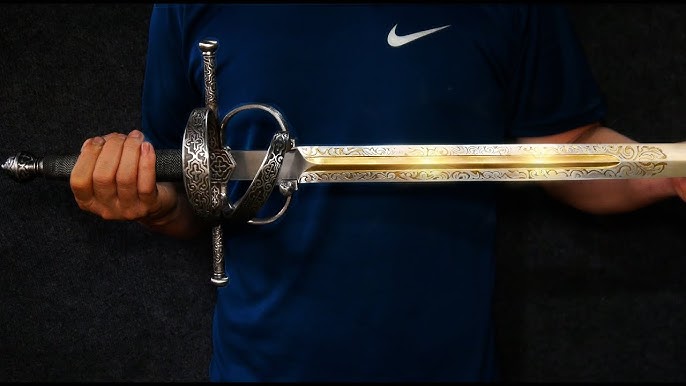
For their most prized creations, especially the swords of chieftains and legendary warriors, the smiths employed a technique that bordered on the magical: pattern-welding. Known today as Damascus steel, this process involved forging together multiple rods of iron and steel with different properties. These rods were heated, twisted, and hammered, then folded upon themselves again and again. The resulting blade was not a single piece of metal but a complex laminate, showcasing stunning, watery patterns on its surface. More importantly, this technique produced a sword that was both incredibly hard-edged and flexible, resistant to shattering in the heat of combat. A pattern-welded sword was the pinnacle of the smith’s art—a perfect fusion of form and function, a weapon worthy of a hero. It was strength, flexibility, and beauty woven into a single, deadly object.
This mastery was not limited to weapons. The smith’s skill was essential for every aspect of Viking life. They forged the chainmail that protected a warrior’s life, each ring painstakingly interlinked with four others. They created the sturdy axe heads that built longships and longhouses, and the intricate filigree brooches that held a woman’s cloak. From the simplest nail to the most ornate helmet, the hand of the smith was everywhere. They were the creators, the innovators, the true backbone of Norse society. They didn’t just forge steel; they forged the very tools of survival, conquest, and legacy.
Claiming your heritage: modern steel in custom Viking creations
Centuries have passed. The longships no longer raid distant shores, and the sagas have faded into history. Yet, the bloodline of Thor—that fierce, unyielding spirit—endures. It lives on in those who refuse to be ordinary, who seek a tangible connection to the primal strength of their ancestors. Today, this connection is being reforged, quite literally, by a new generation of master artisans who are keeping the ancient traditions alive through custom Viking creations.
Modern technology has given us stainless steel and industrial forges, but the soul of the craft remains the same. A modern Viking smith, much like their ancient counterpart, starts with raw steel and, through fire and hammer, imbues it with purpose and spirit. This is where the true magic of custom creation lies. When you commission a piece, you are not simply buying an object; you are participating in its birth. You can choose the design, the materials, the symbols that speak to your own journey.
Imagine holding a custom-forged Viking axe. The handle is carved from ash, the wood of the world tree Yggdrasil, shaped perfectly to your grip. The head is hand-forged from high-carbon steel, its edge honed to a razor sharpness. Perhaps its cheeks are etched with runes of victory or the snarling face of a wolf. This is not a mass-produced replica. This axe has a soul. It carries the echo of the smith’s hammer and the heat of the forge. It is an extension of your own will, a modern symbol of the same strength that cleared forests and won battles a thousand years ago.
The same spirit can be found in custom-made Viking jewelry. A Mjölnir pendant forged from pattern-welded steel carries the legacy of the legendary swords of old. An arm ring, solid and heavy on the wrist, can be crafted from twisted steel and capped with the raven heads of Odin or the wolf heads of Fenrir, a personal totem of wisdom or ferocity. These are not mere accessories. They are statements of identity, modern-day amulets that connect us to the deep well of Norse mythology and the warrior ethos. They are reminders to face our own modern-day battles—in the office, in the gym, in life—with the heart of a Viking.
Owning a custom Viking creation is to claim your heritage. It is an acknowledgment that the strength of Thor is not just a myth, but a living energy. It flows from the ancient smiths, through the sagas, and into the hands of today’s artisans who hammer that spirit into steel. When you wear a hand-forged pendant or hold a custom axe, you are holding a piece of that lineage. You are carrying strength woven in steel, a tangible link to the bloodline of Thor.

 vikings

