
Old English poets warned that wyrd — fate — “bíð ful aræd”: fully fixed, impossible to argue with. That idea is genuinely ancient, shared across the Germanic-speaking world including Viking Age Scandinavia. The nine-square grid symbol sold today as the “Web of Wyrd,” though, has no runestone, no manuscript, and no saga behind it — it’s a modern design built on a very old idea.
Wyrd and Örlög: A Concept the Vikings Took Seriously
In Old Norse, the closest cousin to wyrd is örlög — literally something like “primal layer,” the thing laid down before. It described the idea that a person’s fate was set, woven into the fabric of events, before they were even born. This wasn’t abstract philosophy to the Norse; it shaped how sagas talk about courage. A doomed man who faces his fate calmly is admired specifically because fighting örlög is pointless — the only choice left is how you meet it.
The Old English cognate wyrd survives in Beowulf, where it’s described as sweeping away whoever it chooses, and shows the same fatalism running through the wider Germanic world, not just Scandinavia. That word didn’t disappear with the conversion to Christianity, either — it drifted into Middle English and eventually gave modern English the word “weird,” which originally meant “related to fate” rather than “strange.” Shakespeare’s Weird Sisters in Macbeth are, literally, the Fate Sisters, a distant echo of the same idea explored in this article.
Meet the Norns: The Weavers of Fate
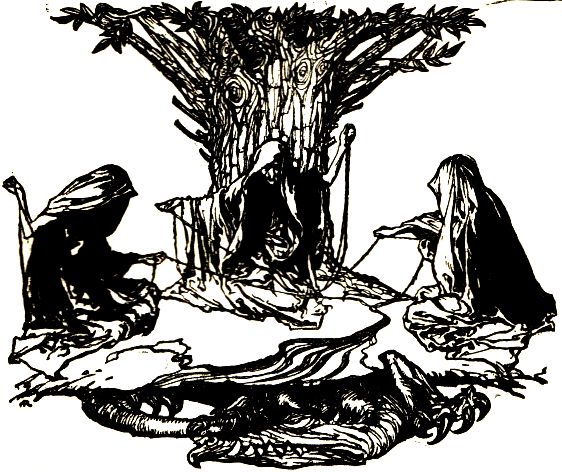
Norse mythology personifies this force as the Norns — Urð, Verðandi, and Skuld — three beings who tend Yggdrasil’s roots and are frequently described spinning or weaving the threads of individual and cosmic destiny. That weaving imagery is exactly where “web of wyrd” as a phrase makes sense: fate as something woven, thread by thread, rather than written.
The Norns appear in Völuspá and are tied closely to Yggdrasil, the world-tree at the center of the Nine Realms, which they water daily to keep it from rotting. Urð in particular gives her name to Urðarbrunnr, the Well of Urð at the tree’s base — the source most closely tied to fate and the past. Some sources also describe minor norns beyond just the three principal sisters, assigned to individual people at birth, which suggests the Norse thought about fate as something both cosmic and deeply personal at the same time.
Wear it: Viking Symbols
Premium Norse-inspired apparel, made on demand.
🇺🇸 Fast US shipping · 🇪🇺 Ships across the EU · 🔒 Secure checkout
The Nine-Square Grid Is a Modern Design
Here’s the honest part. The specific symbol marketed today as the “Web of Wyrd” — nine overlapping lines forming a grid meant to represent every possible direction of fate — doesn’t appear on any Viking Age rune-stone, bracteate, or manuscript. No source from the Viking Age or medieval Iceland names or draws it.
It appears to be a 20th- or 21st-century design, built to visually represent the real concept of örlög and the Norns’ weaving. That doesn’t make it fake or worthless — plenty of meaningful modern symbols are built on old ideas — it just means “ancient Viking symbol” is the wrong label for it. “A modern symbol for an ancient Norse idea” is the accurate one.
You’ll sometimes see it called “Skuld’s net” in shops, which doesn’t make it older — it’s just a second modern nickname for the same 20th- or 21st-century grid design, borrowing the name of the Norn associated with what’s yet to come.
If a seller tells you the grid pattern itself is a Viking Age design, that’s worth pushing back on — politely. The honest pitch (a modern symbol representing a genuinely ancient idea) is a perfectly good one and doesn’t need an invented pedigree to sell it.
Web of Wyrd at a glance
- Wyrd / örlög: a real, ancient concept of fixed fate, attested in Old Norse and Old English sources
- The Norns: Urð, Verðandi, Skuld — mythological spinners and weavers of fate
- Nine-square grid symbol: no historical attestation; a modern design
- How to wear it: as a personal statement about fate, not a claim of Viking Age origin
Why the Idea Still Resonates
Take away the disputed symbol and the underlying idea still holds up. Örlög treats your history — everything you’ve already done and everyone who came before you — as inseparable from your future. Nothing you’ve lived through is separate from what’s still coming. That’s a genuinely useful way to think about consequence and continuity, which is probably why the concept keeps getting rediscovered by new generations, symbol or no symbol.
It also pairs naturally with protective symbolism — see our guide to Norse runes for strength and protection — since accepting your fate and trying to meet it well are closely related ideas in Norse thought. Norse heroes are rarely praised for escaping their fate; they’re praised for how they carry it.
Wearing the Web of Wyrd Meaningfully
If you like the symbol, wear it as what it is: a modern piece of Norse-inspired design representing a real and old idea, not a Viking Age artifact. That framing is more interesting anyway — it’s the same honest approach we take in our full guide to Norse symbols, most of which mix genuine antiquity with later reinterpretation.
Pieces built around the concept work well alongside other fate- and protection-themed Norse jewelry (jewellery, if you spell it the UK way), rather than standing alone as a claimed relic. Pair it with a piece tied to the Norns or Yggdrasil directly, and you’ve got a small, coherent statement about fate rather than a grab-bag of unrelated symbols.
Quick Answers
Is the Web of Wyrd an authentic Viking symbol? No. The concept of wyrd/örlög is ancient and genuinely Norse, but the nine-square grid symbol has no attestation before the modern era.
What does wyrd mean in Norse mythology? It corresponds to Old Norse örlög — fate or destiny understood as already laid down, woven by the Norns.
Who are the Norns? Urð, Verðandi, and Skuld, three beings who tend Yggdrasil and are described spinning and weaving the threads of fate in the Poetic Edda.
Where does the actual Web of Wyrd symbol come from? It’s a modern design, most likely originating in 20th- or 21st-century pagan and tattoo culture, built to visually represent the older concept.
Does the word “weird” really come from wyrd? Yes. Old English wyrd passed into Middle English and eventually gave modern English “weird,” which originally meant “fated” before it came to mean “strange.”

 History Warrior Team


