
Few things carry as much quiet power as an old sign etched into metal or ink. If you have ever wondered about Norse symbols meaning more than mere decoration, you are in good company: these marks tie us to gods, fate and the wide branches of the world tree. This visual guide gathers the best known emblems in one place, gives each an honest short description, and separates what is genuinely Viking-age from the later Icelandic staves that people often mix in. Use it as a map, then follow the links to the fuller single-symbol guides.
Symbols of Odin
The Allfather sits at the centre of Norse myth, and several symbols orbit him directly.
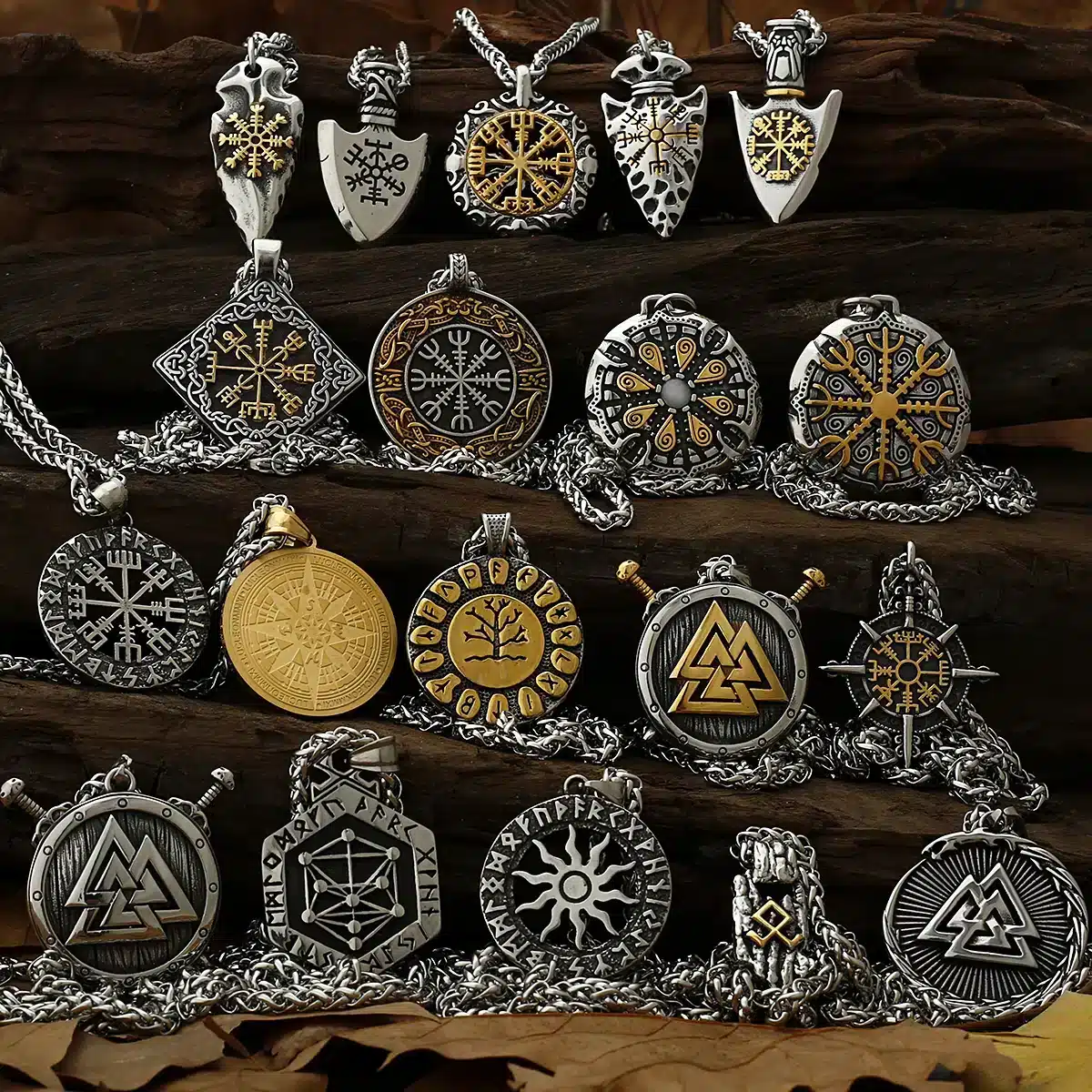
- Valknut — Three interlocking triangles found on Viking-age picture stones and carvings, usually alongside Odin, the slain and the world of the dead. It is widely read as a mark of the honoured slain and of Odin’s power over life and death.
- Huginn & Muninn — Odin’s two ravens, whose names mean “thought” and “memory”. Each dawn they fly across the world and return to whisper what they have seen, standing for the reach of the mind and the value of remembrance.
- Gungnir — Odin’s spear, forged by dwarves and said never to miss its mark. As a symbol it speaks of focus, aim and the unwavering will to see a purpose through.
Protection and the divine hammer
- Mjölnir (Thor’s hammer) — The most common surviving Norse amulet, worn as a pendant across the Viking age. Thor’s hammer both smites giants and hallows weddings, births and oaths, so it carries a double meaning of protection and blessing.
The cosmos and the world tree
- Yggdrasil — The great ash whose roots and branches bind the nine realms together. As a symbol it evokes growth, connection and the idea that everything living shares a single frame.
Runes and the Elder Futhark
Runes were a working alphabet before they were mystic tokens. Each rune stands for a sound and also carries a name and a meaning, from wealth and cattle to ice, the sun or the horse. The older Elder Futhark held twenty-four runes, but the Viking Age itself mostly used the shorter Younger Futhark of sixteen characters, so an “authentic Viking” inscription looks leaner than the fuller elder row people often reach for.
Fate and the threefold knot
- Web of Wyrd — A grid of nine intersecting lines picturing fate as woven by the Norns. The idea of a woven destiny is genuinely old, but this tidy nine-line arrangement is a modern design rather than a surviving artefact.
- Triquetra — A threefold interlace formed from a single unbroken line. It suits ideas that come in threes and appears across several cultures, valued for its clean symmetry and sense of unity.
Later Icelandic and folk staves
These are beloved and worth wearing, but honesty matters: they belong to post-medieval magic and folklore, not the pagan Viking age.
- Vegvísir — The “wayfinder”, said to keep a traveller from losing their way. It is a later Icelandic magical stave, recorded in early-modern grimoires, not a Viking-age design.
- Aegishjálmur (Helm of Awe) — A radiating stave associated with protection and instilling dread in an enemy. Like the Vegvísir, it is a later Icelandic stave rather than something the Norse pagans carved.
- Troll Cross — A bent, horseshoe-like charm meant to ward off trolls and dark spirits. It comes from later Swedish folklore and popular tradition.
Viking-age versus later Icelandic: an honest note
It helps to know which side of the line a symbol falls on. Genuinely Viking-age and Norse-pagan pieces include the Valknut, Mjölnir, the ravens, Gungnir, Yggdrasil and the runes of the Elder and Younger Futhark. By contrast, the Vegvísir, Aegishjálmur and Troll Cross are later Icelandic or Scandinavian magical staves and folk charms, documented centuries after the conversion; the Web of Wyrd is a modern arrangement of an old idea about fate. None of this makes the later designs less meaningful to wear. It simply means an accurate story is a better story, and you can choose a symbol knowing exactly where it comes from.
Take your time with these meanings. Explore the individual symbol guides across the blog for the full history behind each mark, then choose the one whose meaning fits you — whether that is the protection of the hammer, the memory of the ravens, or the woven threads of fate.
Wear it: Viking Symbols
Premium Norse-inspired apparel, made on demand.
🇺🇸 Fast US shipping · 🇪🇺 Ships across the EU · 🔒 Secure checkout
Sizing & shipping for US and EU
Every piece is printed on demand, so nothing sits in a warehouse and each order is made for you. Our apparel runs true to US sizing, so order your usual US size with confidence. For European customers we provide a full EU chest-and-length chart in centimetres on each product page, so you can match measurements rather than guess a conversion. We ship to both the US and the EU, with tracking provided once your made-to-order item is on its way.

 vikings


