
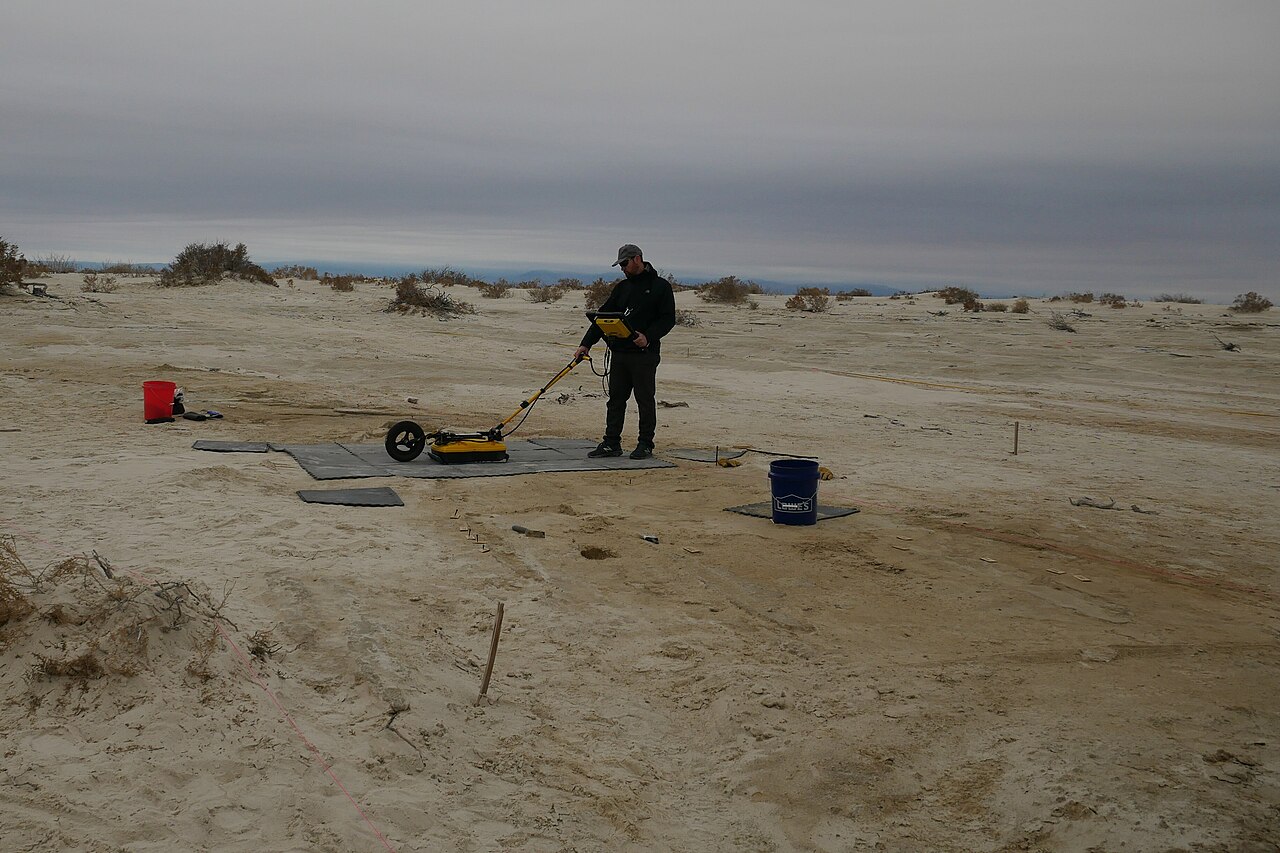
A youth football pitch in Roskilde, Denmark just turned out to be sitting on top of a 770-year-old convent. Archaeologists confirmed a medieval monastery under a football pitch at the city’s Byparken sports fields — without lifting a single trowel — after a ground-penetrating radar survey mapped rooms, a cloister, and a small church buried roughly one meter beneath the turf. Kids have been running drills and playing weekend matches directly over a 13th-century religious complex for decades without anyone knowing it was there.
The find at a glance
- Site: Byparken sports fields, Roskilde, Denmark
- What’s buried: St. Clare’s Convent, believed built around 1254 CE
- Depth: about one meter below the active football pitch
- Method: ground-penetrating radar (GPR) — no excavation, no disturbance to the pitch
- Team: joint Danish-Norwegian survey, National Museum of Denmark and the Norwegian Institute for Cultural Heritage Research (NIKU)
- Found so far: multiple rooms, a cloister, and a small church, in exceptional condition
What the Radar Found Under Byparken
St. Clare’s Convent was one of five medieval monasteries known to have stood in Roskilde, a city that was Denmark’s political and religious capital for much of the Middle Ages. For centuries it was written off as completely lost — paved over, built on, and eventually turned into a place for local kids to play football. The GPR survey changed that in a single pass, returning a clear underground floor plan: several rooms, a cloister walk, and the footprint of a small church, all sitting about one meter under the grass. Lead archaeologist Jesper Langkilde of the National Museum of Denmark and Arne Abel Stamnes of NIKU, who led the GPR survey itself, both flagged the preservation as unusually good — Stamnes called the results among the clearest GPR readings ever recorded from a monastery site in Scandinavia.
Wear it: Viking Bear
Premium Norse-inspired apparel, made on demand.
🇺🇸 Fast US shipping · 🇪🇺 Ships across the EU · 🔒 Secure checkout
St. Clare’s Convent: Built in 1254, “Lost” After the Reformation
St. Clare’s Convent belonged to the Poor Clares, the Franciscan order of nuns founded in the 13th century, and it was built into Roskilde’s dense cluster of religious houses around 1254 CE — a period when the city, not Copenhagen, was the real center of Danish royal and church power. That era ended hard: when the Reformation swept Denmark in the 16th century, monasteries across the country were dissolved, stripped, and often demolished for building material. Local tradition holds that as many as five million bricks from St. Clare’s were carted off to build the nearby Selsø Castle, which would help explain why the convent seemed to vanish so completely that its exact location was, until now, effectively a guess.
Roskilde: Denmark’s Forgotten Capital of Faith
It’s easy to forget, looking at modern Roskilde, that this was once Denmark’s most important city for both crown and church. Roskilde Cathedral, a UNESCO World Heritage Site, has served as the royal burial church of the Danish monarchy since the Middle Ages, and the city grew up around it as a dense cluster of religious institutions — at one point home to as many as a dozen churches and five separate monasteries, of which St. Clare’s Convent was one. Copenhagen didn’t overtake Roskilde as the country’s political center until later in the medieval period, which means a walk across almost any open ground in the old town has a real chance of crossing something that used to be sacred. Byparken, an ordinary patch of sports fields today, is exactly that kind of ground.
Why This Discovery Didn’t Need a Single Shovel
What makes this story more than “old building found” is the how. Ground-penetrating radar sends radio pulses into the ground and reads what bounces back, building a map of buried walls and voids without anyone digging a hole. That matters enormously on a site like Byparken, where a full excavation would mean shutting down an active football pitch for months. Instead, the survey team walked the field with the GPR unit, and the pitch stayed open the whole time — a preview of how much medieval Scandinavia is probably still sitting under parking lots, parks, and playing fields, waiting for the right piece of equipment rather than a lucky shovel strike. It also changes the economics of looking: a GPR pass across a field takes days, not the months and budget a full dig demands, so museums and heritage bodies can survey far more ground on a hunch than they ever could with trowels alone. Expect more of these radar-first discoveries as the equipment gets cheaper and more towns start checking their own parks, pitches, and car parks the same way.
Roskilde Keeps Giving Up Its Buried Past
This isn’t an isolated Danish surprise. Just this year, archaeologists working near Aarhus uncovered a Viking-age textile factory, and a separate dig turned up a hoard of gold arm rings belonging to Denmark’s Viking elite. Norway has had its own run of buried-monastery news too — including the recently rediscovered quarry at Hyllestad, where medieval stonemasons carved Norway’s stone crosses. Denmark and Norway sit on centuries of Viking-Age and medieval construction, and every one of these finds argues the same point: the ground under a lot of ordinary Scandinavian towns is still an open archive.
Quick Answers
Where exactly was the monastery found? Under the Byparken sports fields in Roskilde, Denmark, about one meter beneath an active football pitch.
What was the monastery called? St. Clare’s Convent, a Poor Clares (Franciscan) house believed built around 1254 CE, one of Roskilde’s five medieval monasteries.
How was it found without digging? A joint Danish-Norwegian team from the National Museum of Denmark and NIKU surveyed the site with ground-penetrating radar, which maps buried structures from the surface.
What happened to the convent? It was dissolved and largely demolished during the 16th-century Reformation; local tradition says much of its brick went to build nearby Selsø Castle.
Will archaeologists dig it up? The survey itself required no excavation, and nothing in the reporting so far points to the football pitch being dug up — GPR was chosen precisely because it leaves the site, and the games played on it, undisturbed.

 History Warrior Team


