
More than steel: The sword as a symbol of Viking identity
When we picture a Viking warrior, our minds often conjure images of horned helmets (a myth, but a persistent one), sturdy leather armor, and woolen tunics. We see the beard, the braided hair, and the piercing gaze. But no image is complete without the object that defined their status, their freedom, and their very soul: the sword. More than just a weapon, the Viking sword was the single most important piece of a warrior’s attire, a gleaming testament to their place in the rigid social hierarchy of the North. It was a companion in life and a key to the afterlife.
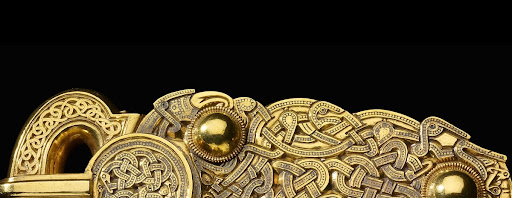
In the Viking Age, the right to carry a weapon was synonymous with being a free man. Thralls and lesser farmhands were forbidden from owning such an item. A sword, therefore, was an immediate and unmistakable visual cue. It declared to the world that its wielder was a person of standing, a karl or a jarl, someone with agency and honor. This was no mere tool; it was an extension of the self. The cost alone placed it in the realm of luxury goods. Crafting a single, high-quality blade required rare materials, immense skill, and countless hours of labor from a master smith. A fine sword could cost more than a small farm, making it an investment passed down through generations as a treasured family heirloom. When a father gave his son a sword, he was passing down not just a weapon, but the family’s legacy, its history of battles won and honor defended.
This deep, personal connection is evident in the Norse practice of naming their swords. Just as a warrior had a name, so too did his blade. Sagas and poems are filled with legendary swords bearing evocative names like Leggbítr (Leg-biter), Gramr (Wrath), or Skofnung. These names gave the weapons a personality, a spirit of their own. The sword was a silent partner in every raid, a loyal defender in every shield wall. It tasted blood, sang its sharp song in the heat of battle, and rested by its owner’s side at night. This personification reveals a profound truth about Viking culture: their attire and accessories were not passive objects. They were active participants in their identity, and the sword was the most vocal of them all. It spoke of wealth, of freedom, of martial prowess, and of a lineage stretching back into the mists of legend. To be without one’s sword was to be naked and vulnerable, not just physically, but socially and spiritually as well.
The sacred craft of the Norse smith
The creation of a Viking sword was an act of near-mystical alchemy, a process that transformed raw, earthly elements into an object of deadly beauty and divine strength. The Norse smith was not merely a laborer but a revered master of his craft, a figure who held power over fire and iron. His forge was the heart of the community’s martial strength, and the techniques he employed were sophisticated, secretive, and astonishingly effective. At the pinnacle of this craft was the art of pattern-welding, a method so complex it imbued the blades with a life and spirit all their own.
Pattern-welding, often referred to as a form of “Damascus steel,” involved taking multiple rods of iron and steel with different properties and forge-welding them together. The smith would heat, twist, and hammer these rods into a single billet, folding them over and over again. This painstaking process accomplished two things. Functionally, it distributed the hard, brittle high-carbon steel and the soft, flexible low-carbon iron throughout the blade, creating a weapon that could hold a razor-sharp edge without shattering on impact. Aesthetically, it created stunning, intricate patterns that flowed across the surface of the steel, often resembling serpents, waves, or braids. Each pattern was unique to the smith’s hand, a signature of his skill etched into the very core of the weapon. When the blade was finally ground, polished, and etched with a mild acid, these hypnotic designs would emerge from the steel, a visual promise of the blade’s hidden strength.
The most legendary examples of this craft are the famed Ulfberht swords. Dating from the 9th to 11th centuries, these blades are marked with the inscription +VLFBERH+T. Analysis of these weapons has stunned archaeologists and metallurgists alike. They were made of crucible steel, a material with a carbon content so high and impurities so low that it was not seen again in Europe for nearly a thousand years. This steel was incredibly strong, sharp, and flexible, making an Ulfberht sword vastly superior to most other blades on the battlefield. How Norse smiths acquired or created this advanced metal remains a subject of intense debate, with some theories pointing to trade routes that reached as far as modern-day Afghanistan. Whatever their origin, these swords were the absolute peak of Viking craftsmanship. The hilt, guard, and pommel were often lavished with equal attention, crafted from wood, bone, or antler and frequently inlaid with intricate designs in silver, bronze, or gold. To hold one was to hold a masterpiece, a perfect fusion of art and war, forged by a master who understood the sacred bond between a warrior and his blade.
Odin’s blessing: Runes, rituals, and the path to Valhalla
For the Viking warrior, a sword was not simply a piece of masterfully crafted steel; it was a conduit to the divine, a physical object charged with the power of the gods. And no god was more intimately connected with the warrior and his blade than Odin. The Allfather, the god of wisdom, poetry, and magic, was also the god of war and death. It was in his name that warriors fought, and it was to his hall, Valhalla, that the worthy were carried after a glorious death in battle. The sword was the instrument of this destiny, the key that unlocked the gates to a warrior’s paradise.
This connection was often made explicit through the carving of runes. Runes were more than just an alphabet to the Norse people; they were symbols of immense power, capable of shaping reality, offering protection, and ensuring victory. The Týr rune (ᛏ), named for the one-handed god of justice and single combat, was a common inscription on swords, believed to guide the warrior’s hand and grant him strength in a duel. The name Ulfberht itself, inscribed on the legendary blades, can be seen as a form of branding that also acted as a powerful charm, a maker’s mark that guaranteed both quality and a kind of magical potency. By carving these sacred symbols into the steel, a smith or warrior was imbuing the weapon with Odin’s own magic, turning it from a simple tool into a holy relic consecrated for war. The sagas are filled with tales of magical swords, like Gram, the blade Odin himself thrust into the tree Barnstokkr, to be claimed only by the hero Sigmund. These stories reinforced the belief that the finest blades were touched by the gods.
Ultimately, the sword’s most profound spiritual purpose was its role in a warrior’s death. The Viking belief system placed enormous value on dying bravely in combat. A peaceful death in a warm bed was seen as a dishonorable “straw death,” leading to the grim underworld of Hel. The only path to the glorious halls of Valhalla, where warriors would feast and fight until the final battle of Ragnarök, was to die on the battlefield with a weapon in hand. The sword was the warrior’s ticket to this esteemed afterlife. It was the final, most crucial piece of attire one wore when meeting the Valkyries. This belief transformed the act of fighting. Every swing of the blade was not just an attempt to defeat an enemy, but an offering to Odin, a demonstration of worthiness. The gleam of a Viking sword on a blood-soaked field was more than the reflection of the cold northern sun; it was the light of a warrior’s soul, reaching for its place among the gods.

 vikings


