
The soul of the warrior: More than just sharpened steel
To understand the Viking warrior, one must look beyond the horned helmet myth and delve into the heart of their culture. Central to their identity, their status, and their very survival was the blade they carried. It was more than a tool or a weapon; it was an extension of their being, a symbol of their honor, and often, a sacred object believed to be touched by the gods themselves. In the world of the Northmen, a warrior’s attire was incomplete without the cold, hard weight of steel at their side. These were not mass-produced implements of war. They were blades forged in fire, quenched in ritual, and carried in the name of Odin, the Allfather—god of war, wisdom, and death.

The relationship between a Viking and their weapon was deeply personal. A fine sword could be a family heirloom, passed down through generations, its hilt worn smooth by the hands of fathers and sons. An axe might be the one constant companion on a long and perilous voyage, serving as both a wood-chopping tool and a fearsome battlefield weapon. These blades bore names, were celebrated in sagas, and were believed to possess their own spirit or will. They were integral to the Norse conception of fate, or wyrd, shaping a warrior’s destiny in the shield wall and determining their path to the great halls of Valhalla. To carry a blade was to carry the weight of legacy and the promise of glory, a tangible link between the mortal realm of Midgard and the divine halls of Asgard.
The sword: A symbol of status and saga
In the Viking Age, the sword was the undisputed king of weapons. It was a mark of immense prestige, a luxury item that was far from standard issue. While a spear or an axe might be found in the hands of any free farmer, a sword was the accessory of the jarl, the hersir, and the successful raider. The cost of producing one was astronomical, requiring vast amounts of precious iron and the highly specialized skills of a master smith. This exclusivity made the sword a powerful statement piece, a clear indicator of wealth and social standing within the Norse hierarchy.
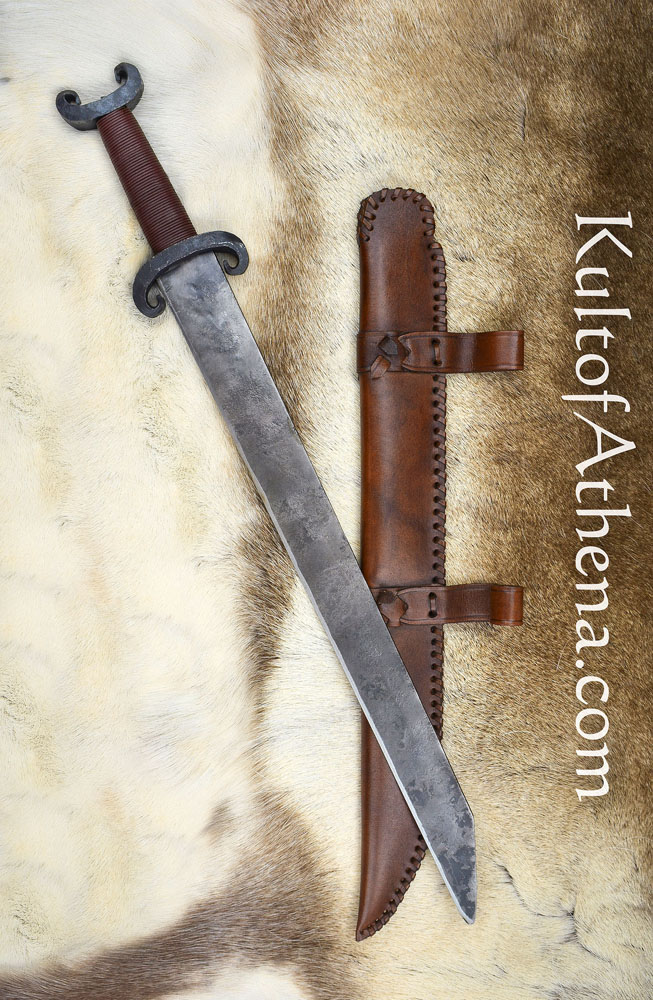
The artistry lavished upon these weapons speaks volumes about their importance. The most legendary were the pattern-welded blades, created by twisting and forge-welding multiple rods of iron and steel together. This complex process not only created blades of superior strength and flexibility but also resulted in stunning, serpent-like patterns that seemed to ripple across the surface of the steel. These were true masterpieces, often finished with hilts of cast bronze, silver, or even gold, intricately decorated with knotwork and animal motifs that told stories of myth and lineage. The famous Ulfberht swords, bearing the maker’s inscription, were of such high-quality carbon steel that their metallurgical composition baffled historians for centuries, standing as a testament to the incredible skill of Viking-age smiths.
Beyond its material value, the sword was steeped in symbolism and saga. Swords were given names like Leg-biter or Foe-reaper, imbuing them with a distinct personality. They were central figures in the epic poems and sagas, often possessing magical properties or a will of their own. A sword was a trusted companion, a silent witness to a warrior’s greatest triumphs and their final moments. Upon a great chieftain’s death, his sword was often buried with him, a necessary tool for the journey to the afterlife. In other cases, it was passed down to his heir, carrying with it the history and honor of the entire clan. To own a fine sword was to own a piece of a living legend, a blade that could carve not only flesh and bone but a name into history itself.
The axe: The people’s blade and battlefield fury
If the sword was the weapon of the elite, the axe was the soul of the common Viking. It was the great equalizer on the battlefield, a democratic and devastatingly effective tool of war. Almost every Norse household possessed an axe. It was an essential implement for felling trees, shaping timber for longships, and building homes. This ubiquity meant that when the call to arms came, the average farmer or woodsman could grab the very tool he used every day and march to war. This familiarity made the axe a natural and brutally efficient extension of its wielder’s arm.
Viking axes were not the clumsy, oversized weapons often depicted in fiction. They were balanced, surprisingly swift, and came in a variety of forms suited for different purposes. The small, one-handed bearded axe, with its characteristic downward-swept blade, was a versatile sidearm. The ‘beard’ could be used to hook an opponent’s shield or leg, pulling them off-balance and creating a fatal opening. But the most iconic and feared of all was the Dane axe. Wielded with two hands, this long-hafted weapon could deliver bone-shattering, shield-splitting blows. The sight of a charging line of Vikings, the crescent heads of their Dane axes held high, was enough to strike terror into the hearts of their enemies. In the hands of a skilled warrior, its reach and power could keep multiple opponents at bay, cleaving through mail and helmet with terrifying ease.
The axe is deeply intertwined with the popular image of the Viking warrior, particularly the berserker. It represents a raw, untamed fury—a connection to the wilder aspects of Norse culture. While a swordsman might fight with calculated grace, the axeman fought with raw power and momentum. The axe was not about intricate parries; it was about overwhelming force. It was the weapon of the raider, the homesteader, and the shield-biter, a symbol of the fierce and pragmatic spirit that allowed the Norse to not only survive but thrive in a harsh world. It was the people’s blade, forged for both creation and destruction, embodying the dual nature of the Viking age.
The seax: The versatile companion of every Northman
Tucked into the belt of nearly every man and woman in the Viking Age was the seax. Often overlooked in favor of the more dramatic sword and axe, this single-edged long knife was arguably the most important and versatile blade in Norse society. Ranging in size from a small utility knife to a short, sword-like weapon, the seax was the ultimate multi-tool. It was a personal and constant companion, used for everything from preparing food and mending gear to carving wood and defending one’s life in a sudden skirmish.
The design of the seax is simple and brutally effective. It features a long, straight cutting edge and a thick spine that tapers to a sharp point, a shape often referred to as a ‘broken back’ style. This design made it excellent for both slicing and stabbing. For the Viking warrior, the seax served as a reliable sidearm and a weapon of last resort. If a sword was broken or an axe was lost in the chaos of the shield wall, the seax was the final line of defense. Its shorter length made it ideal for close-quarters combat, where a long sword would be too clumsy to wield effectively. It was a weapon for the desperate, brutal fighting that occurred when shields locked and armies clashed in a visceral struggle for survival.
Like all Viking accessories, the seax and its sheath were often objects of personal expression and skilled craftsmanship. The blades themselves could be pattern-welded, and the handles were crafted from wood, bone, or antler, sometimes intricately carved. The leather sheaths that housed them were even more ornate, often decorated with stamped patterns and fitted with bronze or silver mounts. Worn horizontally at the front or back of the belt, the seax was always within easy reach. It was more than just a tool or a weapon; it was a fundamental part of everyday Viking attire, a piece of equipment so essential that to be without it would be like being without a hand. It represented self-reliance, readiness, and the practical, resilient spirit of the Norse people.

 vikings


