
The very name ‘Viking’ conjures an image of raw power. It’s the image of a warrior, silhouetted against a grey northern sky, clad not just in furs and leather, but in the cold, hard promise of steel. This armor, this second skin of iron and resolve, was more than mere protection. It was a statement of intent, a vessel of belief, and a physical manifestation of the strength they drew from their gods. At the heart of this warrior ethos stood Thor, the thunderer, the god of strength, whose might was synonymous with the very metal that shielded his mortal followers.
To understand Viking attire is to understand that every piece of steel, from the simplest helmet ring to the most intricate pattern-welded sword, was part of a lineage. It was a bloodline that traced back to the mythical forges of the dwarves, who crafted Mjölnir itself, and flowed through the hands of the village smith, whose hammer rang with echoes of Thor’s own. This is the story of that bloodline—of strength woven not just in wool and linen, but hammered and folded into the very soul of Viking steel.
The forge of the gods: mythology meets metallurgy
In the heart of every Viking settlement, amidst the sounds of daily life, was a place of elemental power: the blacksmith’s forge. The smith was no mere artisan; he was a master of fire and iron, a figure of immense respect and even a little fear. His ability to transform black, brittle bog iron into a shield boss that could turn a blade or an axe head that could split a helm was seen as a kind of magic, a communion with the raw forces of the earth.
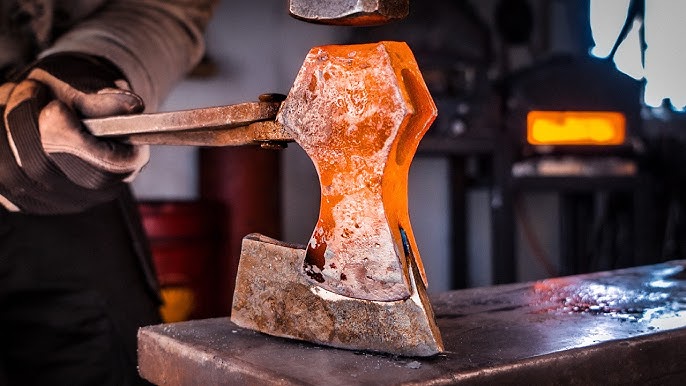
This reverence was deeply rooted in Norse mythology. The greatest treasures of the gods were not born of magic alone, but of unparalleled craftsmanship. It was the dwarves, the master smiths of the nine realms, who forged Odin’s spear Gungnir, Freyr’s golden boar Gullinbursti, and most importantly, Thor’s hammer, Mjölnir. These tales reinforced a core belief in Viking society: that true power was created, not just claimed. The smith’s hammer, striking the incandescent metal on the anvil, was a mortal echo of Thor’s hammer striking down giants. Every spark that flew was a prayer, every quench in the water a baptism of strength.
The process itself was a saga. The primary source of iron was a humble, rust-colored sludge harvested from peat bogs. This ‘bog iron’ was smelted in clay shaft furnaces, a grueling process requiring immense skill to achieve the right temperature to separate the iron bloom from the slag. This bloom was not yet steel; it was a spongy mass of iron that had to be hammered, folded, and purified repeatedly. This was the blacksmith’s true art—working the impurities out of the metal, layering it, and in the case of the finest blades, forge-welding different types of iron and steel together to create a weapon that was both hard enough to hold an edge and flexible enough not to shatter. This technique, known as pattern-welding, produced blades with stunning, serpentine patterns, a visible testament to their legendary quality and the smith’s mastery. The Viking warrior who carried such a blade or wore armor from a respected smith was carrying the culmination of this immense effort—a piece of the earth, transformed by fire and skill, and imbued with the spirit of the gods.
More than mail: the anatomy of a Viking warrior’s armor
When we picture a Viking warrior gearing up for a raid or battle, we often imagine a brutal simplicity. Yet, their defensive attire was a sophisticated, multi-layered system designed for mobility, resilience, and survival. While only the wealthiest could afford a full suit of metallic armor, the principles of protection were understood by all, from the landed jarl to the humble bondsman.
The iconic (and misunderstood) helmet
First, we must dispel a persistent myth: the horned helmet. This was a romantic invention of the 19th century, with no basis in archaeological reality. A horn on a helmet is a liability in a fight, easily grabbed or struck. The real Viking helmet was a brutally practical piece of engineering. The most famous example, the 10th-century Gjermundbu helmet, provides the perfect blueprint. It was a ‘spangenhelm’ design, constructed from a framework of iron bands to which four separate plates were riveted, forming a rounded cap. This was an efficient way to create a strong, protective dome without needing the technology to forge a single, solid piece. It featured a distinctive ‘spectacle’ guard that protected the eyes and nose, giving its wearer an intimidating, almost skeletal appearance. Some helmets also had an aventail, a curtain of chainmail that hung from the back and sides to protect the neck and throat. This was the face of the Viking warrior: pragmatic, intimidating, and built for war.
The heart of defense: the byrnie
The centerpiece of a wealthy warrior’s protection was the byrnie, or chainmail shirt. A byrnie was an incredible investment of time and resources. Each one was made of thousands of individual iron rings, each one painstakingly drawn into wire, wound around a rod, cut into a single ring, and then linked together. The best mail used a pattern of alternating solid, punched rings and riveted rings, creating a strong, flexible mesh that was highly resistant to slashing attacks. A mail shirt could weigh over 10 kilograms (22 pounds) and would have been worth a small fortune, often passed down through generations as a treasured heirloom. It was the ultimate status symbol, signifying a warrior of great renown and wealth. Wearing it was like wearing the family’s honor, a heavy mantle of steel and responsibility.
Layers of resilience: beneath the steel
Directly against the skin, a Viking wore a linen undertunic. Over this, and crucially, beneath the chainmail, a warrior wore a padded garment known as a gambeson or aketon. This thick jacket, made from layers of wool or linen stuffed with fleece, horsehair, or cloth scraps, was absolutely essential. While chainmail is excellent at stopping a cut, it does little to absorb the concussive force of a blow. A sword strike or axe blow could still break bones or cause massive internal bruising without this padded layer. The gambeson absorbed the shock, turning a potentially lethal blow into a survivable one. For warriors who could not afford a byrnie, a thick leather jerkin or a well-made gambeson was their primary torso defense, proving that the simplest garments, when crafted with purpose, were vital threads in the fabric of survival.
The striking arm: weapons as extensions of will
If armor was the Viking’s resilience, his weapon was his voice. It was the tool through which he exerted his will upon the world, an extension of his body and spirit. The armory of the Norseman was diverse and practical, with each weapon holding a specific place in the hierarchy of the battlefield and the warrior’s heart.
The soul of the Viking: the sword and seax

The Viking sword was the aristocrat of weapons. Expensive to produce and requiring immense skill from the smith, it was a symbol of high status. The typical Norse sword was a double-edged blade about 90 centimeters long, with a shallow fuller (a groove down the center) to lighten the blade without sacrificing strength. The hilt, pommel, and guard were often lavishly decorated with silver or copper inlays, knotwork, and geometric patterns. The most legendary of these were the Ulfberht swords, a series of blades from the 9th to 11th centuries marked with the inscription +VLFBERH+T. Made of high-quality crucible steel that was astonishingly pure for the era, they were stronger, sharper, and more flexible than their contemporaries. To own an Ulfberht was to wield a technological marvel, a weapon that felt alive in the hand. Alongside the sword, nearly every Viking carried a seax—a single-edged knife that ranged from a small utility tool to a fearsome short sword. It was the everyday companion, used for everything from cutting food to cutting a foe in the chaotic press of a shield wall.
The reach of the northman: the spear and axe
Despite the sword’s prestige, the most common weapon on the Viking battlefield was the spear. It was cheap to make, requiring far less iron than a sword, and incredibly versatile. It could be thrown or used as a thrusting weapon in the tight confines of a shield wall. A wall of Viking warriors with their shields interlocked and a hedge of spearpoints bristling from its front was a terrifying and effective formation. But the weapon that truly captured the violent spirit of the Viking Age was the axe. The long-handled Dane axe, with its massive, bearded head, was a weapon of pure devastation. It required two hands to wield, meaning the warrior had to forsake the protection of his shield, but its power was unparalleled. It could cleave through a shield, a helmet, or a man with a single, fearsome blow. It was the signature weapon of the elite, from the Varangian Guard of Constantinople to the housecarls of English kings, a tool that combined agricultural utility with terrifying martial prowess.
Echoes of the thunder god: symbolism etched in steel
For the Viking warrior, the act of arming himself was a ritual. The weight of the mail settling on his shoulders, the snug fit of the helmet, the familiar grip of his weapon—it was a transformation. But this was not merely a physical change; it was a spiritual one. The steel they wore and wielded was a canvas for their deepest beliefs, a way to carry the protection of the gods into the chaos of battle.

No symbol was more potent or more widespread than the Mjölnir, the hammer of Thor. While most commonly worn as a silver pendant, its power was invoked everywhere. The sign of the hammer might be made over a drink before a journey or over a weapon before a fight, consecrating it and imbuing it with Thor’s protective strength. The hammer represented more than just destructive force; it was a symbol of order against chaos, a protector of mankind, and a guarantee of righteous strength. A warrior entering a fight with the symbol of the hammer on his person felt the backing of the thunder god himself. His own strength was amplified by divine might.
Other symbols and carvings also adorned their gear. Runes, the sacred letters of the Norse, might be etched into a sword’s pommel or a spear’s shaft. These were not just letters but ideograms containing inherent power. A ‘Tiwaz’ rune (ᛏ) might be carved for victory in battle, invoking the god Týr, while an ‘Algiz’ rune (ᛉ) could be used for protection. Animal motifs were also common. The wolf and the raven, creatures associated with the all-father Odin, signaled a devotion to the god of war and wisdom. The bear or the boar might be a totem for a specific warrior or clan, representing ferocity and tenacity. These symbols turned a simple set of tools for war into a sacred collection of relics. Each piece told a story, not just of its owner, but of his faith, his ancestors, and his place in the cosmos.
In the end, the bloodline of Thor was not one of genetics, but of spirit. It flowed through the arm of the smith as he hammered iron into steel, and through the arm of the warrior as he lifted his shield to the sky. The strength woven into Viking steel was a trinity of forces: the physical strength of expertly forged metal, the mental strength of a hardened warrior, and the spiritual strength of a people who believed the gods fought beside them. In every gleam of a helmet, every link of mail, and every sharp edge of a blade, the fierce spirit of the North lives on.

 vikings


