
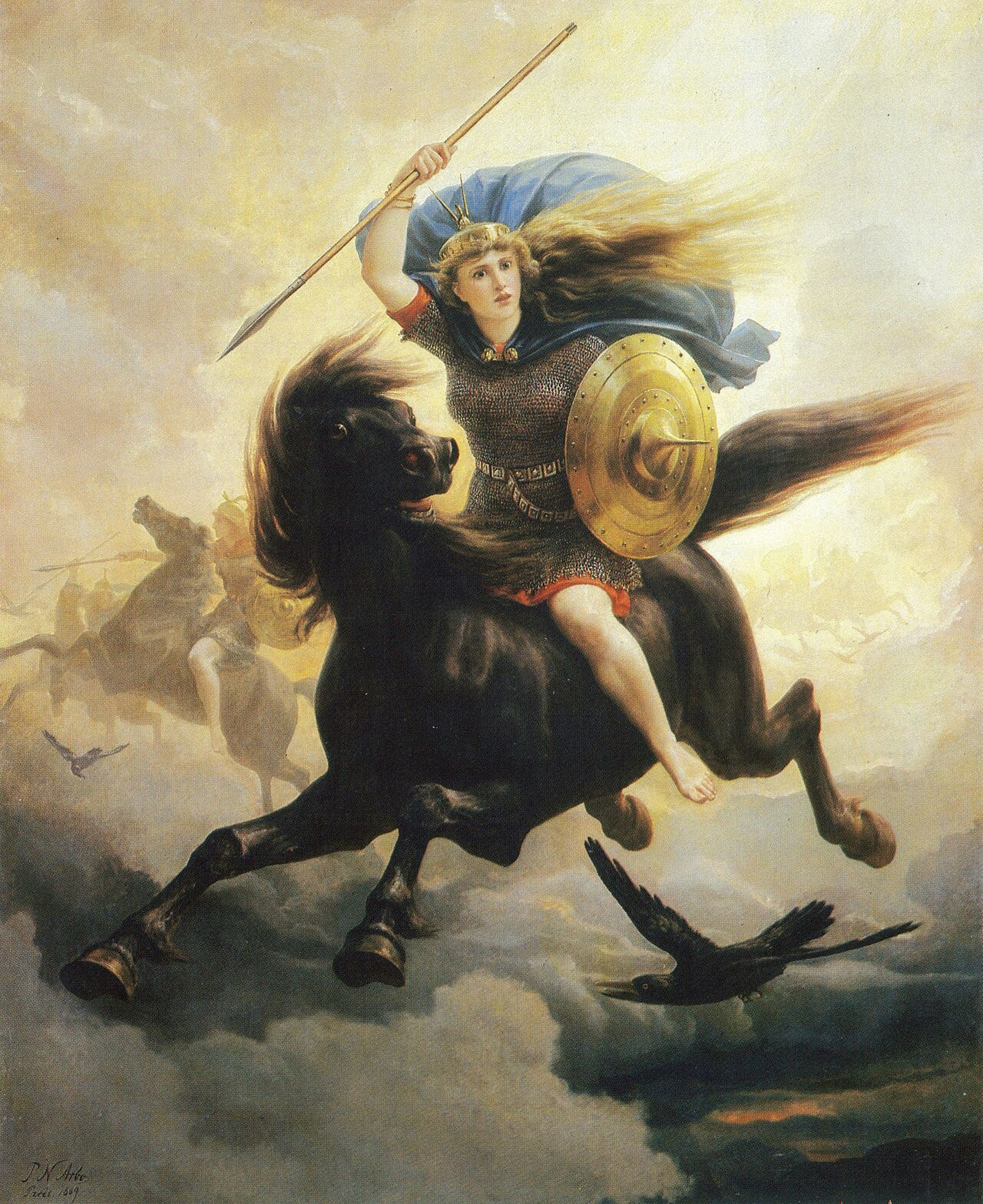
The valkyrie meaning comes straight from Old Norse: valkyrja translates to “chooser of the slain.” These were Odin’s handpicked agents on the battlefield, deciding which fallen warriors rode to Valhalla and which went elsewhere. They turn up across the Poetic Edda and the sagas as armed women on horseback — not the winged, doe-eyed figure pop culture prefers, but something closer to war spirits with a grim job to do.
Valkyries at a glance
- Old Norse valkyrja means “chooser of the slain”
- They served Odin, selecting warriors for Valhalla
- Named individuals include Brynhildr, Sigrdrífa, and Sváva
- Sources describe them pouring mead for the einherjar in Valhalla
- The poem Darraðarljóð shows them weaving war on a loom strung with human remains
What “Valkyrie” Actually Means in Old Norse
Break the word down and it stops sounding mysterious. Valr means “the slain,” specifically those killed in battle, and kjósa means “to choose.” Put them together and you get valkyrja — “chooser of the slain.” The Old English cognate wælcyrge shows up glossing the Roman Fury Erinys, which tells you how early medieval scribes read these figures: not princesses, not muses, but something closer to fate made flesh on a battlefield.
Snorri Sturluson lays out the job description plainly in the Prose Edda’s Gylfaginning: Odin needs warriors for the final battle of Ragnarok, so he sends valkyries to every fight to decide who lives, who dies, and who gets escorted to Valhalla afterward. That’s the core function. The horses, the armor, the mead-pouring all sit on top of it.
Viking Age picture stones carry the same idea in stone, centuries before any of these poems were written down. The Tjängvide and Ardre image stones from Gotland show a mounted rider being greeted by a woman offering a drinking horn — widely read as a valkyrie welcoming a fallen warrior. It’s rare to get a piece of Viking Age visual art that lines up this closely with the later literary sources.
Choosing the Slain: Their Role on the Battlefield and in Valhalla
In Grímnismál, Odin names a working roster of valkyries — Hrist, Mist, Skeggöld, Skögul, Hildr, Þrúðr, Hlökk, Herfjötur, Göll, Geirönul, Randgríð, Ráðgríð, and Reginleif — and says they carry ale to the einherjar gathered in Valhalla. The job doesn’t end on the battlefield. Once a valkyrie has chosen a warrior, she often escorts him to Odin’s hall and serves him there, which is why so much Viking Age art shows a mounted woman offering a drinking horn to an arriving rider.
Not every valkyrie works for Odin’s hall alone. Half the slain, per Grímnismál, go to Freyja’s field Fólkvangr instead — she gets first pick. The valkyries carry out that split, which puts them closer to battlefield administrators than glamorous escorts.
Wear it: Till Valhalla
Premium Norse-inspired apparel, made on demand.
🇺🇸 Fast US shipping · 🇪🇺 Ships across the EU · 🔒 Secure checkout
Named Valkyries: Brynhildr, Sigrdrífa, and the Individuals Behind the Myth
Most valkyries in the sources are a list of names and nothing more — Hildr, Göll, Skögul — but a handful get full stories. Brynhildr is the biggest: in the Völsunga Saga and the Poetic Edda’s Sigrdrífumál, she defies Odin by giving victory to the wrong king in battle, and he punishes her by pricking her with a sleep-thorn and locking her inside a ring of fire until a man brave enough rides through to wake her. That man is Sigurd, and their tangled romance drives most of the Völsung cycle.
Some manuscripts treat Sigrdrífa, the valkyrie Sigurd wakes and who teaches him runic lore in the Sigrdrífumál, as a separate figure from Brynhildr. Others merge them into one. The overlap isn’t sloppiness on the medieval scribes’ part — it reflects how fluid these figures already were by the time anyone wrote them down. A valkyrie could be divine agent, doomed lover, and teacher of runes all in the same character, depending on which saga you’re reading.
A less famous case is Sváva, who protects the hero Helgi Hjörvarðsson in the Poetic Edda’s Helgakviða Hjörvarðssonar. She guards him in battle and loves him, and the poem hints at a form of rebirth binding the two of them across different heroic lives — a theme the Völsung material echoes again with Sigurd and Brynhildr.
The Darraðarljóð: Weaving War on a Loom of Human Remains
If you want the starkest image of what valkyries actually were, skip the paintings and read the Darraðarljóð, preserved in Njáls Saga. A man named Dörruð watches twelve figures — valkyries — working a loom before the Battle of Clontarf in 1014. Except the loom isn’t strung with wool. The warp is made of human intestines, weighted with severed heads; the shuttle is an arrow; the reed that beats the weave into place is a sword. As they work, they sing about deciding who dies at Clontarf, weaving the battle’s outcome into fabric before it even starts.
That poem is a gut-punch precisely because it strips away the romance. These aren’t decorative figures handing out mead — they’re weaving fate out of the bodies of men they’ve already chosen. It’s some of the bleakest, most powerful verse to survive from the Viking Age, and it’s a better introduction to what a valkyrie meant to a Norse audience than any modern illustration.
Valkyries vs. Shieldmaidens: Myth, History, and the Pop-Culture Blur
People often collapse valkyries and shieldmaidens into the same idea, but the sources keep them separate. Valkyries are supernatural — agents of Odin operating between worlds. Shieldmaidens, where the sagas mention them, are described as flesh-and-blood women who fought as warriors, and the evidence for real armed women in Viking society is its own, separate discussion worth reading in full.
Modern film and television tend to flatten both into one look: leather armor, a sword, wings optional. That’s fine as costume design, but it erases a real distinction the Norse themselves drew. A valkyrie chooses your fate from outside the battle. A shieldmaiden, if she existed as described, stood inside it with a shield on her arm. The reverence that grew up around that kind of death is also exactly what powers the modern Til Valhalla phrase you’ll see on tattoos and memorials today.
Quick Answers
What does valkyrie literally mean? It comes from Old Norse valkyrja, built from valr (“the slain”) and kjósa (“to choose”) — literally “chooser of the slain.”
Do valkyries only serve Odin? Mostly, but not entirely. Grímnismál says Freyja gets first choice of half the battle-dead for her field Fólkvangr, with the valkyries carrying out that division.
Is Brynhildr a valkyrie? Yes — in the Völsunga Saga and Sigrdrífumál she’s depicted as a valkyrie punished by Odin and later woken by Sigurd, though some texts treat her as distinct from the similar figure Sigrdrífa.
Are valkyries the same as shieldmaidens? No. Valkyries are supernatural battlefield spirits serving Odin; shieldmaidens, as described in the sagas, were human women who fought as warriors.

 History Warrior Team


