
Whispers from the bog: The quest for iron
Before the first hammer could fall, before the forge could roar to life, the journey of a Viking blade began not in fire, but in water and earth. The Norse world was rich with natural resources, but its most crucial element for war and status lay hidden in the murky, acidic depths of its bogs and marshes. This was the source of ‘bog iron,’ the humble origin of a legendary weapon.
Unlike later societies that mined iron ore from mountainsides, the Vikings were masters of their environment, harvesting this unique resource with patience and ingenuity. Bog iron, or siderite, forms when iron dissolved in groundwater precipitates out in wetlands, creating small, lumpy nodules. For the Norse, this was a gift from the land. Parties would venture into the marshlands, probing the soft earth with long poles, feeling for the tell-tale hard lumps beneath the surface. It was a laborious, muddy task, a far cry from the fiery drama of the forge, but it was the essential first step.
Once gathered, these rust-colored concretions were far from ready to become a sword. They had to be smelted, a magical and mysterious process in the Viking Age. The Norse blacksmith would construct a bloomery, a simple clay-and-stone shaft furnace. Layering the bog iron with charcoal, he would bring the furnace to a blistering temperature using hand-operated bellows. For hours, even days, the smith would tend the fire, a solitary figure coaxing metal from stone. This wasn’t smelting in the modern sense; the iron never fully melted. Instead, the intense heat and carbon monoxide from the charcoal separated the iron from its impurities (slag), causing it to congeal into a spongy, porous mass known as a ‘bloom.’
Pulling this glowing, dripping bloom from the furnace was a moment of triumph. It was raw, impure, and unwieldy, but it was iron. The real work was just beginning. The smith had to repeatedly heat and hammer the bloom, a process called consolidation, to beat out the remaining slag and weld the iron particles into a solid, workable bar. From the mud of the bog, a material worthy of a warrior’s hand was slowly, painstakingly born.
The rhythm of the hammer: The art of pattern-welding
The soul of a truly great Viking sword was not in its simple iron content, but in the near-mythical technique used to forge it: pattern-welding. This was the pinnacle of Norse blacksmithing, a complex art that turned a simple weapon into a masterpiece of metallurgy and a symbol of immense wealth and power. A pattern-welded sword was not just strong; it was a legend in its own right, its surface shimmering with serpent-like patterns that seemed to move in the light.
The genius of pattern-welding lay in its solution to a fundamental problem. Iron that is high in carbon (steel) is very hard and holds a sharp edge, but it is brittle. Iron with low carbon content is softer, more flexible, and resistant to shattering, but it cannot hold an edge. How could a smith create a blade that was both razor-sharp and resilient enough to withstand the brutal shock of combat? The answer was to combine them.
The process began with the smith creating several bars of iron and steel. He would then forge-weld these bars together, heating them until they were white-hot and hammering them into a single, laminated billet. This was only the beginning of the magic. The smith would then twist this billet, sometimes tightly, sometimes loosely, creating intricate internal patterns. He might even twist multiple bars in opposite directions and then forge them side-by-side. This twisting and folding process was repeated, layering the metals like a complex pastry. These twisted rods formed the core of the blade, providing a flexible and incredibly strong spine.
For the cutting edge, the smith would forge-weld a separate strip of high-carbon steel onto the patterned core. This gave the sword its lethal sharpness, the part that would bite deep into a shield or mail. The entire blade was then hammered to its final shape—broad, double-edged, with a gentle taper leading to a rounded point, designed more for slashing than thrusting.
After hours of hammering, shaping, and grinding, the final, crucial step was the quench. The smith would heat the blade to a precise temperature, judging the color of the glowing metal by eye, before plunging it into water or oil. This rapid cooling hardened the steel edge to its maximum potential. The blade was then carefully tempered, or re-heated to a lower temperature, to relieve the stresses from quenching and give the entire sword the perfect balance of hardness and flexibility. When the blade was finally polished and etched with a mild acid, the breathtaking patterns of the welded core were revealed. These were not merely decorative; they were the visible proof of the blade’s inner strength and the smith’s profound skill.
More than steel: Crafting the hilt and scabbard
A Viking blade, as magnificent as it was, was incomplete without its hilt. The hilt was where the warrior connected with his weapon, and it was a work of art in its own right, reflecting the owner’s status, wealth, and even regional identity. The construction of the hilt was a collaboration of different crafts, transforming the forged blade into a finished, battle-ready sword.
The hilt assembly consisted of several parts: the grip, the crossguard (or lower guard), and the pommel. The grip itself was typically made of organic materials like wood, bone, or antler, carved to fit the warrior’s hand. To improve the grasp, it was often wrapped tightly with leather cord or wire. These materials have rarely survived in the archaeological record, leaving us to imagine the feel of the sword in a Viking’s hand.
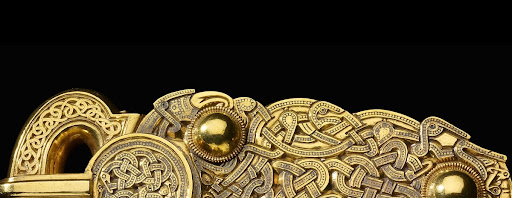
What did survive, in spectacular fashion, were the metal components. The crossguard and pommel were not just functional, serving to protect the hand and balance the blade, but were also canvases for extraordinary artistic expression. Smiths and artisans would cast these parts in iron or bronze and then embellish them with intricate inlays of silver, copper, and even gold. The designs were a tapestry of Norse art, featuring geometric knots, stylized animals, and fierce, beastly faces. The Petersen typology, a system used by archaeologists to classify Viking swords, is based almost entirely on the different styles of these hilts, which evolved over centuries.
The pommel was often a two-part construction, a testament to the complexity of the work. It secured the tang of the blade (the narrow part that extends through the hilt) by being peened over the top, locking the entire assembly together. This made the sword a single, solid unit, strong and reliable.
Just as important was the scabbard, which protected the precious blade from the elements and the warrior from the blade’s keen edge. A Viking scabbard was a sophisticated construction. It was typically made from two thin lathes of wood, carved to perfectly match the blade’s shape. The inside was often lined with fleece, wool, or fur. This wasn’t for comfort; the natural lanolin in the wool protected the iron from rust, a constant threat in the damp northern climate. The wooden core was then covered with leather, which was often decorated with stitched patterns or fitted with a bronze or silver chape at the tip. A suspension system of leather straps allowed the sword to be worn at the hip, ready to be drawn at a moment’s notice.
The Ulfberht enigma: A sword ahead of its time
Among the thousands of Viking swords that have been unearthed, a special group stands apart, bearing the mysterious inscription +VLFBERH+T. These are the Ulfberht swords, weapons of such astonishing quality that they have baffled historians and metallurgists for decades. They represent a leap in technology so profound that they were centuries ahead of their time, and their existence challenges our understanding of the Viking world.

The secret of the Ulfberht swords lies in their steel. While most European blades of the era were made from pattern-welded iron with inconsistent carbon content, the Ulfberht blades were forged from high-quality crucible steel. This steel had a much higher and more uniform carbon content—up to three times more than other swords—and had been smelted at temperatures high enough to remove nearly all impurities, or slag. The result was a blade that was unbelievably strong, sharp, and flexible, all at once. An Ulfberht sword could slice through lesser blades and bend without breaking, making it a truly terrifying weapon on the battlefield.
The enigma is where this advanced material came from. Crucible steel was not being produced in Europe during the Viking Age; the technology was thought to be confined to Central Asia and the Middle East. This has led to the compelling theory that the raw material for these swords, in the form of steel ingots, traveled thousands of miles to Scandinavia via the Volga trade routes. This suggests the Vikings were not isolated raiders, but key players in a global trade network that connected the northern world with the bustling economies of the Abbasid Caliphate.
The +VLFBERH+T inscription itself is a mark of this quality, likely the name of a renowned Frankish workshop that held the secret to working with this exotic material. Its fame was such that many lesser-quality copies were produced, with misspelled variations of the name, trying to capitalize on the legendary brand. Finding a genuine Ulfberht is like finding a relic from the future. It is a testament to the fact that the Viking Age was not a dark age, but a period of incredible innovation, long-distance connection, and the relentless pursuit of perfection in the art of war. The Ulfberht is the ultimate Viking blade, a fusion of Scandinavian craftsmanship and global technology, born of fire, iron, and a spirit that knew no borders.

 vikings


