
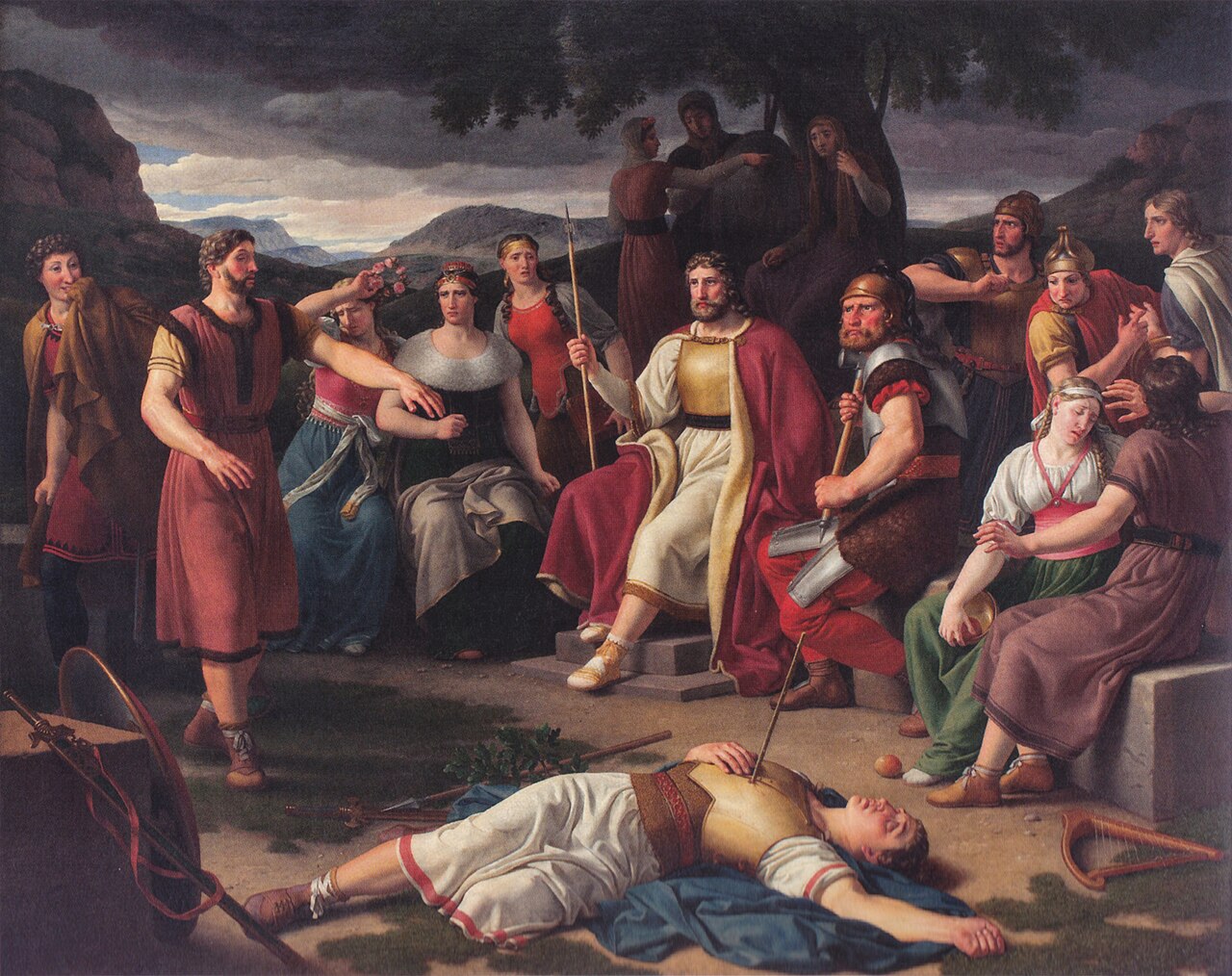
Ask any Norse mythology fan which god’s death actually made them feel something, and most will say Baldur, the most beloved god in Norse mythology. He wasn’t known for conquest or trickery — he was the one god everyone agreed was good, and his death is the hinge the whole mythology turns on. Here’s what actually happens in the story, and why not even the gods could undo it.
Baldur at a glance
- Son of Odin and Frigg, husband of Nanna, associated with light, beauty, and justice
- Killed by a dart of mistletoe, thrown by his blind brother Höðr at Loki’s urging
- Frigg had sworn nearly everything on earth to spare him — except mistletoe, which she judged too small to bother asking
- His death is one of the signs that Ragnarok is approaching
- Primary sources: the Poetic Edda (Völuspá, Baldrs draumar) and Snorri Sturluson’s Prose Edda (Gylfaginning)
The Dreams That Warned of Death
The story opens with Baldur having troubled dreams. In the poem Baldrs draumar (“Baldur’s Dreams”), Odin is disturbed enough by his son’s nightmares that he rides Sleipnir down to Hel itself and wakes a dead völva (seeress) to ask what they mean. Her answer is blunt: Baldur will die, and the killer will be his own brother.
Frigg, Baldur’s mother, isn’t willing to accept that as settled fact. She does what any Norse mother in her position would do — she goes out and negotiates with the entire world.
Frigg’s Oaths — and the One Plant She Skipped
Frigg travels the Nine Realms and extracts a promise from fire, water, iron, stone, earth, disease, beasts, birds, poison, and every tree, that none of them will ever harm her son. It works almost too well: the gods turn it into a party game, throwing weapons and stones at Baldur for sport and laughing as everything bounces off him harmlessly.
Loki notices the loophole immediately. Mistletoe, growing west of Valhalla, seemed too young and small to bother swearing an oath from — so Frigg had skipped it. Loki disguises himself, tricks the information out of her, and cuts a sprig of it.
Wear it: The Heart of Odinism
Premium Norse-inspired apparel, made on demand.
🇺🇸 Fast US shipping · 🇪🇺 Ships across the EU · 🔒 Secure checkout
Loki’s Trick and the Blind God’s Throw
Höðr, Baldur’s brother, is blind and can’t join in the game of throwing things at Baldur. Loki offers to guide his hand and hands him a dart made from the mistletoe. Höðr throws it, guided by Loki — and it kills Baldur instantly. The other gods are too shocked, and too bound by the sanctity of the assembly ground where the game is happening, to strike Loki down on the spot.
It’s worth pausing on how differently this reads from a typical hero’s death. Baldur doesn’t fall in single combat or in a raid — he’s killed in what was supposed to be a safe game, by a family member who had no idea what he was holding.
Hermod’s Ride to Hel and the Weeping That Wasn’t
Odin sends another son, Hermod, riding Sleipnir through nine nights of dark valleys to reach Hel, the underworld realm ruled by the giantess of the same name. Hermod finds Baldur there and asks for his release. Hel agrees to one condition: if everything in the world, living and dead, weeps for Baldur, she’ll let him return to the gods. If even one thing refuses, he stays.
Messengers are sent across the realms, and everything weeps — people, animals, stones, metal, trees. Everything, except one giantess sitting in a cave, who gives her name as Þökk (“Thanks”) and refuses, saying she’ll only weep dry tears for Baldur and that Hel can keep what she has. Most tellings, including Snorri’s, assume Þökk was Loki in disguise. Because of her, Baldur stays in the underworld.
A Ship Named Hringhorni
Baldur’s funeral is one of the most vivid scenes in the Prose Edda. His body is carried to his ship, Hringhorni, said to be the largest ship ever built. The gods can’t launch it themselves, so they send for the giantess Hyrrokkin, who shoves it into the water with such force that the rollers underneath spark and the ground shakes.
Nanna, Baldur’s wife, dies of grief on the spot and is placed on the pyre beside him. A dwarf named Litr gets kicked into the fire by Thor for standing in the way. Odin leans down and whispers something into his dead son’s ear — a line never explained anywhere in the surviving sources, and it has puzzled readers for a thousand years.
Baldur’s Return After Ragnarok — and Saxo’s Other Version
Baldur’s story doesn’t end at Ragnarok. According to Völuspá, after the final battle destroys the old world, a new one rises from the sea, green and renewed — and Baldur returns from Hel, reconciled with Höðr, to help live in it. It’s one of the few genuinely hopeful notes in the whole mythology: even the gods’ worst loss gets undone eventually.
There’s a second, very different Baldur worth knowing about. The 12th-century Danish historian Saxo Grammaticus, in his Gesta Danorum, tells a version with no mistletoe and no Loki-guided arrow at all. His Balderus is a demigod warrior rivaling the human hero Hother for the love of Nanna, eventually killed in battle by a magic sword. It reads much more like a saga than a myth, and it’s a good reminder that medieval writers didn’t always agree on how the gods’ stories went.
Baldur himself isn’t tied to one single iconic symbol the way Thor is to Mjölnir, but his story of loss and eventual renewal echoes through Norse-inspired art and jewelry today — our Norse Symbols guide covers the visual side of that tradition.
Quick Answers
Why couldn’t mistletoe be sworn to an oath? Frigg judged it too young and small to pose any threat, so she never asked it to promise not to harm Baldur — the one gap Loki found and used.
Who killed Baldur? His blind brother Höðr threw the fatal dart, but Loki engineered the whole plan and guided the throw.
Does Baldur come back to life? Not immediately — he stays in Hel because the giantess Þökk, likely Loki in disguise, refuses to weep for him. He’s prophesied to return after Ragnarok.
Is there another version of the Baldur myth? Yes. Saxo Grammaticus’s Gesta Danorum tells a more human, warrior-focused version with different characters and no mistletoe at all.

 History Warrior Team


