
The soul of the warrior: more than just a weapon
Picture a Viking warrior, standing on the prow of a longship as mist clings to the fjord. In his hand is not merely a tool of war, but a symbol of his very being: his sword. For the Norsemen, a blade was far more than sharpened steel. It was a legacy, a status symbol, a loyal companion, and often, a vessel of legend. These were not mass-produced implements; each one was a masterpiece born from the union of earth, fire, and the almost supernatural skill of a master blacksmith. The clang of the hammer on the anvil was a song of creation, echoing the myths of dwarven smiths who forged treasures for the gods themselves. To understand the Viking Age is to understand the sacred process that turned rust-colored mud into a weapon worthy of a saga. This is the story of fire and iron—the birth of a Viking blade.
The journey from raw material to a gleaming, pattern-welded sword was a testament to patience, generational knowledge, and a deep reverence for the materials. The smith was not just a craftsman but a kind of alchemist, transforming the mundane into the magnificent. He had to understand the personality of the fire, the secrets of the metal, and the spirit of the warrior who would wield his creation. Let’s step through the smoke of the forge and witness this incredible transformation, from a humble gift of the earth to the razor-sharp edge that carved history.
The quest for iron: a gift from the bogs
Before a sword could be forged, its essential lifeblood had to be gathered. The Vikings did not have sprawling mines in the modern sense. Instead, they turned to the damp, acidic wetlands that were abundant across Scandinavia: the bogs. Here, through a slow, natural process, iron hydroxides would precipitate out of the groundwater, forming lumpy, rust-colored concretions known as bog iron, or myrmalm in Old Norse. This was a gift from the earth, but one that demanded hard labor to claim.

Harvesting bog iron was a communal and seasonal activity. Men would wade into the marshes, probing the murky depths with long poles to locate the deposits. Once found, the ore was dredged up with rakes or dug out by hand. It was a messy, arduous task, but essential for the survival and strength of their community. After being collected, the raw ore was washed and then roasted over an open fire. This crucial step served two purposes: it dried the ore completely and burned off organic impurities, making the smelting process more efficient.
With the prepared ore in hand, the true magic could begin. The Norse blacksmiths used a bloomery furnace, a simple yet effective structure typically built from clay, stone, and earth. It was a chimney-like furnace that could reach scorching temperatures, but not quite high enough to fully liquefy the iron. Inside, alternating layers of bog iron and charcoal were carefully stacked. The charcoal served as both the fuel and the reducing agent, its burning carbon monoxide stripping oxygen atoms from the iron ore.
Operating the bloomery was an art form. It required hours of back-breaking work, feeding the fire and pumping bellows to force air into the furnace and raise the temperature. The smith had to listen to the sounds of the furnace and watch the color of the flames to know when the process was complete. At the end of a successful smelt, the furnace would be broken open to reveal not a pool of liquid metal, but a spongy, porous mass of iron mixed with impurities called slag. This was the bloom. Hot and glowing, it was immediately dragged from the furnace and hammered relentlessly. This initial hammering compacted the iron and forced out much of the molten slag, sending brilliant showers of sparks into the smoky air of the forge. This bloom was the raw, untamed heart of the metal, the very first step in its long journey to becoming a legendary blade.
The serpent in the steel: mastering pattern welding
The iron bloom, while a triumph of early metallurgy, was not yet fit to be a sword. It was wrought iron—strong and malleable, but too soft to hold a sharp edge. The Vikings also had access to steel, which is iron with a higher carbon content. Steel is much harder but more brittle. A sword made purely of steel might shatter on impact with a shield or another blade. So, how did the Viking smiths create a weapon that was both devastatingly sharp and resilient enough to survive the chaos of battle? The answer lies in a beautiful and complex technique: pattern welding.

Often mistakenly called Damascus steel, the Viking method involved forge-welding multiple pieces of iron and steel together. The smith would begin by preparing several thin bars of metal—some of soft wrought iron, others of harder steel. These bars were then stacked, heated in the forge until they glowed a brilliant yellow-white, and hammered together until they fused into a single, composite billet. This was just the beginning.
The true artistry came in the next steps. The smith would heat the billet again and twist it tightly, like wringing out a cloth. He might twist one section clockwise and another counter-clockwise. He could also fold the billet back on itself and hammer it flat, doubling the number of layers. By repeating these processes of twisting, folding, and welding, the smith created intricate, controlled patterns within the metal. The different types of metal, layered and contorted, would eventually form stunning, serpent-like or herringbone designs running down the core of the finished blade.
This wasn’t just for decoration; it was advanced engineering. The pattern-welded core gave the sword flexibility and shock absorption, preventing it from breaking. The all-important cutting edge, however, was forged separately from the best high-carbon steel the smith had. This hard steel edge was carefully fire-welded onto the patterned core. The result was the best of both worlds: a flexible spine with an edge that could be honed to razor sharpness and would resist dulling. After the blade was forged and shaped, it was meticulously ground and polished using progressively finer abrasives like sandstone and grit. Finally, the blade was given a mild acid bath—often using something as simple as sour whey or vinegar. This etching process ate away at the different metals at slightly different rates, making the breathtaking, internal patterns leap into view. To look upon a pattern-welded blade was to see the soul of the sword, a testament to the smith’s complete mastery over fire and iron.
A vessel for the spirit: crafting the hilt, sheath, and name
With the blade complete, the sword was still just a piece of patterned steel. It needed a hilt to be held, a sheath for protection, and, for the greatest of weapons, a name to give it life. The hilt, or handle, was a complex assembly of its own, comprising a crossguard, a grip, and a pommel. These components were not only functional but also served as a canvas for artistic expression and a declaration of the owner’s wealth and status.
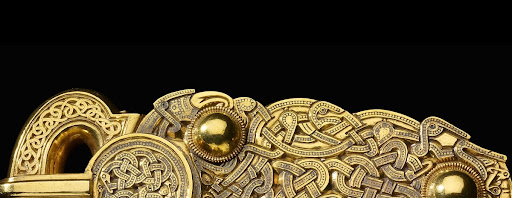
The crossguard and pommel were the metal components that balanced the blade and protected the hand. Early Viking swords often had simple organic guards, but they evolved into the elaborate forms classified by historian Jan Petersen. These pieces were typically made of iron, but a wealthy jarl or king might have a sword with a hilt of bronze or solid silver, intricately carved or inlaid with copper, silver, and gold wire. The designs often featured complex knotwork, mythical beasts, or powerful geometric patterns, turning the weapon into a piece of breathtaking jewelry. The grip, which fit between the guard and pommel, was usually built on a wooden core and wrapped in leather, wire, or even sharkskin for a secure hold.
Equally important was the scabbard, or sheath. A Viking would never carry a naked blade. The scabbard protected the finely crafted edge from the elements and protected the wearer from the blade. It was typically constructed from two thin pieces of wood, carved to perfectly fit the blade, and then covered in leather. The inside was often lined with wool or fur. This wasn’t for comfort; the natural lanolin in the fleece oiled the blade, constantly protecting it from its greatest enemy: rust. The scabbard, too, could be decorated with metal fittings at the throat and tip (the chape), reflecting the quality of the sword within.
Finally, the most personal touch was giving the sword a name. In the sagas, legendary heroes wielded swords with evocative names like Leg-biter, Gram (Wrath), or Angurvadal (Stream of Anguish). Naming a sword imbued it with a personality, a history, and a destiny. It was no longer an object but a partner in adventure and a keeper of oaths. A named sword was an heirloom, passed from father to son, carrying the glory and stories of its previous owners into the next generation. It was the final step in transforming a product of the forge into a legendary artifact, a true member of the Viking community.

 vikings


