
The echoes of Yggdrasil: Odin’s sacrifice and the birth of runic wisdom
In the biting winds of the North, where sea-foam kissed the shores and mountains scraped the heavens, communication was more than just spoken words. It was a sacred art, a bridge between the mortal realm of Midgard and the divine halls of Asgard. At the heart of this connection lay the runes — potent, angular symbols carved into wood, stone, and steel. These were not merely letters of an ancient alphabet; they were vessels of cosmic power, a gift paid for in blood and sacrifice by the Allfather himself.

To truly understand the weight and reverence the Norse people held for the runes, we must travel to the center of the cosmos, to the great World Tree, Yggdrasil. It is here, as told in the poetic verses of the Hávamál (The Sayings of the High One), that Odin, driven by an unquenchable thirst for knowledge, made the ultimate sacrifice. He hung himself from a branch of the great tree, pierced by his own spear, Gungnir, for nine long nights. He offered himself to himself, a harrowing ordeal between life and death, wind and rain, starvation and agony.
In this trance-like state, suspended between the worlds, he peered into the depths of the Well of Urd, where the Norns weave the fates of all beings. It was there, at the very brink of oblivion, that the secrets of the universe were revealed to him. With a final, guttural cry, he seized them — the runes. He didn’t invent them; he discovered them, pulling their innate power from the cosmic ether. This act frames the runes not as a human creation, but as a fundamental part of the universe’s fabric, a divine language waiting to be understood by those worthy.
This origin story is crucial to the Viking psyche. It established that true power and profound wisdom were not given freely. They had to be earned through trial, sacrifice, and a willingness to face the darkness within and without. The runes, therefore, were treated with immense respect. Those who could read, carve, and interpret them, the rune masters or erilar, were seen as powerful figures in the community. They were the custodians of this sacred knowledge, capable of healing the sick, protecting warriors, cursing enemies, and seeking guidance from the gods. Every scratch of a rune upon a surface was an echo of Odin’s sacrifice, a channeling of the primal magic that binds the Nine Realms together.
Whispers on wood and steel: runes in the Viking community
While the origin of the runes is steeped in divine myth, their application was deeply woven into the practical, everyday fabric of Norse life. They were a constant, tangible presence, turning ordinary objects into items of power and significance. The Vikings saw magic not as something separate from the world, but as an inherent force within it, and runes were the key to unlocking and directing that force.
Nowhere was this more evident than in the life of a warrior. A Viking’s axe was not just a tool for cleaving wood; it was an extension of their will. Their shield was not just a plank of wood and leather; it was a bastion against fate. To bolster their effectiveness, runes were painstakingly carved onto weapons and armor. The Tiwaz rune (ᛏ), named for the god of war and justice, Týr, was a common inscription on sword hilts and spearheads, a prayer for victory and courage in the chaos of battle. The Algiz rune (ᛉ), symbolizing a stag’s antlers or an upturned hand, was etched onto shields and helmets as a powerful ward of protection, deflecting harm both physical and magical. This was not mere decoration; it was enchantment, a way of imbuing cold steel with divine purpose.
Beyond the battlefield, runes were personal companions. They were worn as amulets and jewelry, small pieces of bone, silver, or amber bearing symbols of luck, health, and prosperity. A traveler might wear a Raidho rune (ᚱ) for a safe journey, while a farmer might keep a Fehu rune (ᚠ) talisman to encourage wealth and a good harvest. These were intimate connections to the gods, a silent conversation carried in a pouch or worn against the skin. This tradition speaks volumes about the Norse relationship with spirituality — it was personal, practical, and ever-present.
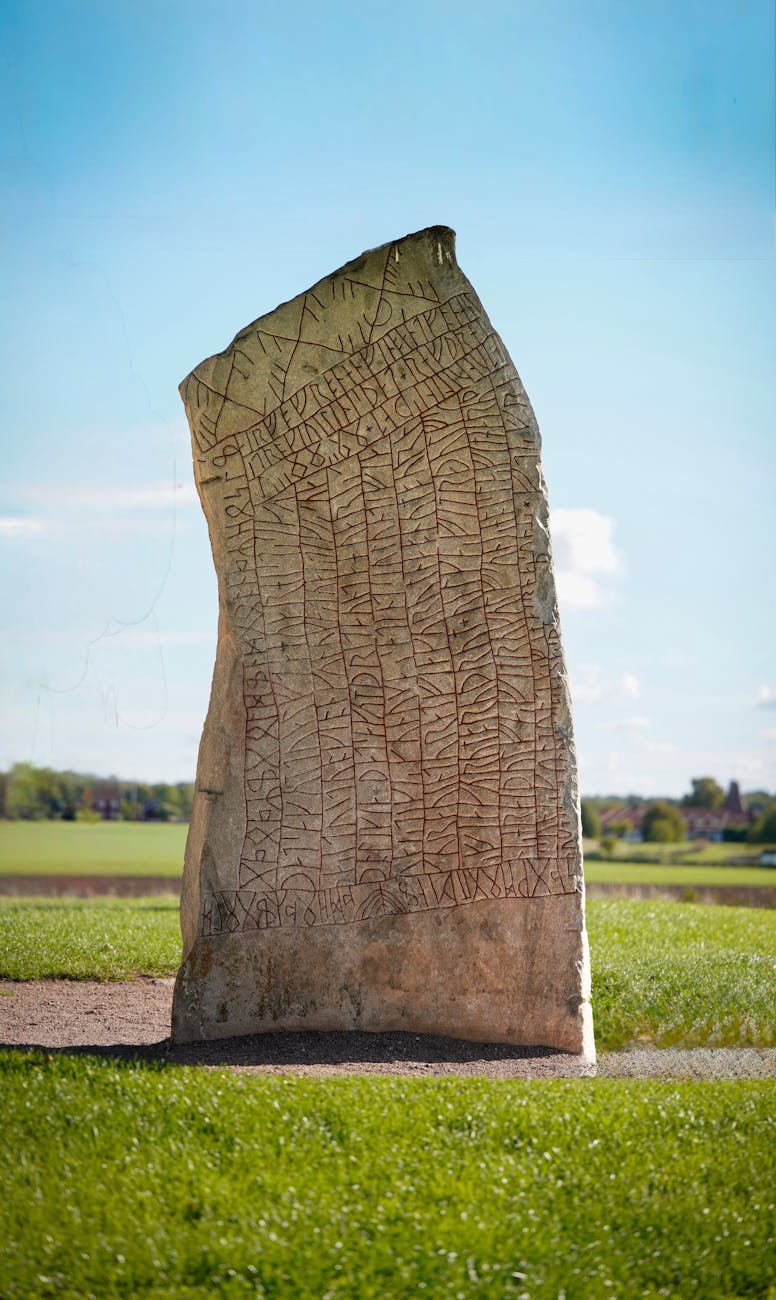
The most public and enduring examples of runic power are the great runestones that still pepper the Scandinavian landscape. These towering monuments were far more than simple gravestones. They were declarations. A runestone might commemorate a great chieftain, detail a successful raiding voyage to the east, or serve as a legal document marking a claim to land. They were the social media of the Viking Age, broadcasting a family’s legacy and power to all who passed by. Often, they included complex carvings of Norse myths and ended with a protective or commemorative runic formula, ensuring the memory—and the spirit—of the person honored would endure for eternity.
Casting the threads of fate: runes as a tool for divination
Perhaps the most mysterious and profound use of the runes was in the art of divination. The Norse people believed in Wyrd, a complex concept of fate. It was not a rigid, predetermined path, but rather a tapestry woven by the three Norns at the base of Yggdrasil. While one could not escape their fate, one could seek to understand its threads and navigate them with wisdom. Rune casting was the primary method for gaining this insight.
The practice was often overseen by a shamanic practitioner, most famously the Völva or seeress. These powerful women were respected and feared, for they could journey in spirit, speak with the dead, and interpret the will of the gods. As described by the Roman historian Tacitus in his account of the Germanic tribes (the cultural ancestors of the Vikings), the method was deceptively simple. A practitioner would take small pieces of a fruit-bearing tree, inscribe them with runes, and cast them onto a white cloth. Then, while praying to the gods, they would pick up three pieces at random and interpret their meaning based on the question asked.
Each rune in the Elder Futhark—the oldest runic alphabet—held three layers of meaning: a phonetic sound, a common name (like ‘cattle’ for Fehu or ‘ice’ for Isa), and a deeper, esoteric concept. The diviner’s skill was in weaving these concepts together to form a coherent and insightful reading. A casting was not a simple ‘yes’ or ‘no’ answer. It was a complex snapshot of the energies and influences surrounding a situation. It offered guidance, revealed hidden obstacles, and illuminated the most favorable path forward. It was a way to consult the Norns themselves, to ask for clarity on the path one was walking.
The tools for this practice were themselves sacred. Runes were often carved from the wood of a yew, ash, or oak tree and kept in a leather pouch. The act of creating your own rune set was a spiritual ritual. Each symbol would be carefully carved, often colored with red ochre or one’s own blood to imbue it with life force and personal energy. This deep, personal connection to the tools was essential, as the runes were not seen as an external oracle but as a mirror reflecting the hidden knowledge of the cosmos and the wisdom within oneself. Through the runes, a Viking could engage directly with the currents of fate, not as a passive victim, but as an active participant in their own epic saga.
From the Allfather’s agony on the World Tree to the warrior’s prayer on the battlefield, the runes were the lifeblood of Norse spirituality. They were the language the gods understood, the symbols that shaped reality, and the keys that unlocked the mysteries of fate. They remind us that for the people of the North, the world was alive with meaning, and every object, every action, and every life was a story written in the ancient, unyielding script of the runes.

 vikings


