
Wear it: The Heart of Odinism
Premium Norse-inspired apparel, made on demand.
🇺🇸 Fast US shipping · 🇪🇺 Ships across the EU · 🔒 Secure checkout
Odin’s sacrifice: the divine origin of runic knowledge
In the heart of the Norse cosmos, long before the first longship cut through the icy spray of the North Sea, a profound sacrifice took place. The runes, those angular and mysterious symbols etched into stone, wood, and steel, were not a mere invention of mortals. They were a divine secret, a cosmic power wrested from the very fabric of fate by Odin, the Allfather, in an act of supreme self-sacrifice. To truly understand the power of the runes is to first understand the price that was paid for them.

The story, as told in the ancient Poetic Edda, specifically in the Hávamál (The Sayings of the High One), is a chilling testament to the Viking pursuit of wisdom. Odin, ever thirsty for knowledge, sought the ultimate prize: the secrets held by the Norns, the weavers of destiny. He knew this knowledge could not be requested or bartered for; it had to be seized. To do this, he undertook a shamanic ordeal of immense suffering. He wounded himself with his own spear, Gungnir, and hung himself from a branch of Yggdrasil, the World Tree that connects the Nine Realms.
For nine days and nine nights, he hung, suspended between life and death, wind-whipped and starving, offered as a sacrifice from himself, to himself. In this agonizing, liminal state, his physical eyes closed and his inner eye opened. He peered down into the Well of Urd, the source of all fate, and at the precipice of death, the runes revealed themselves to him. With a final, desperate cry, he grasped them, absorbing their power and meaning into his very being before falling from the great tree. This was no simple academic exercise; it was a violent, transformative acquisition of primordial power. The runes were born of pain, wisdom, and the will of a god. This divine origin story is the foundation of their sanctity. For the Norse people, to carve a rune was to echo Odin’s sacrifice and tap into the same cosmic energy he had claimed. It imbued every symbol with a weight and significance far beyond that of a simple letter. Each line and intersection was a piece of divine language, a fragment of the secrets of the cosmos, ready to speak to those brave enough to listen.
The Elder Futhark: a cosmic map in 24 symbols
When we think of an alphabet, we think of a neutral set of characters used to form words. The Elder Futhark, the oldest form of the runic alphabets used by Germanic tribes, was profoundly different. It was a living system, a spiritual framework where each of the 24 runes was a key to a much deeper concept. It was less an alphabet and more a lexicon of power, a way to categorize and interact with the forces of the world.
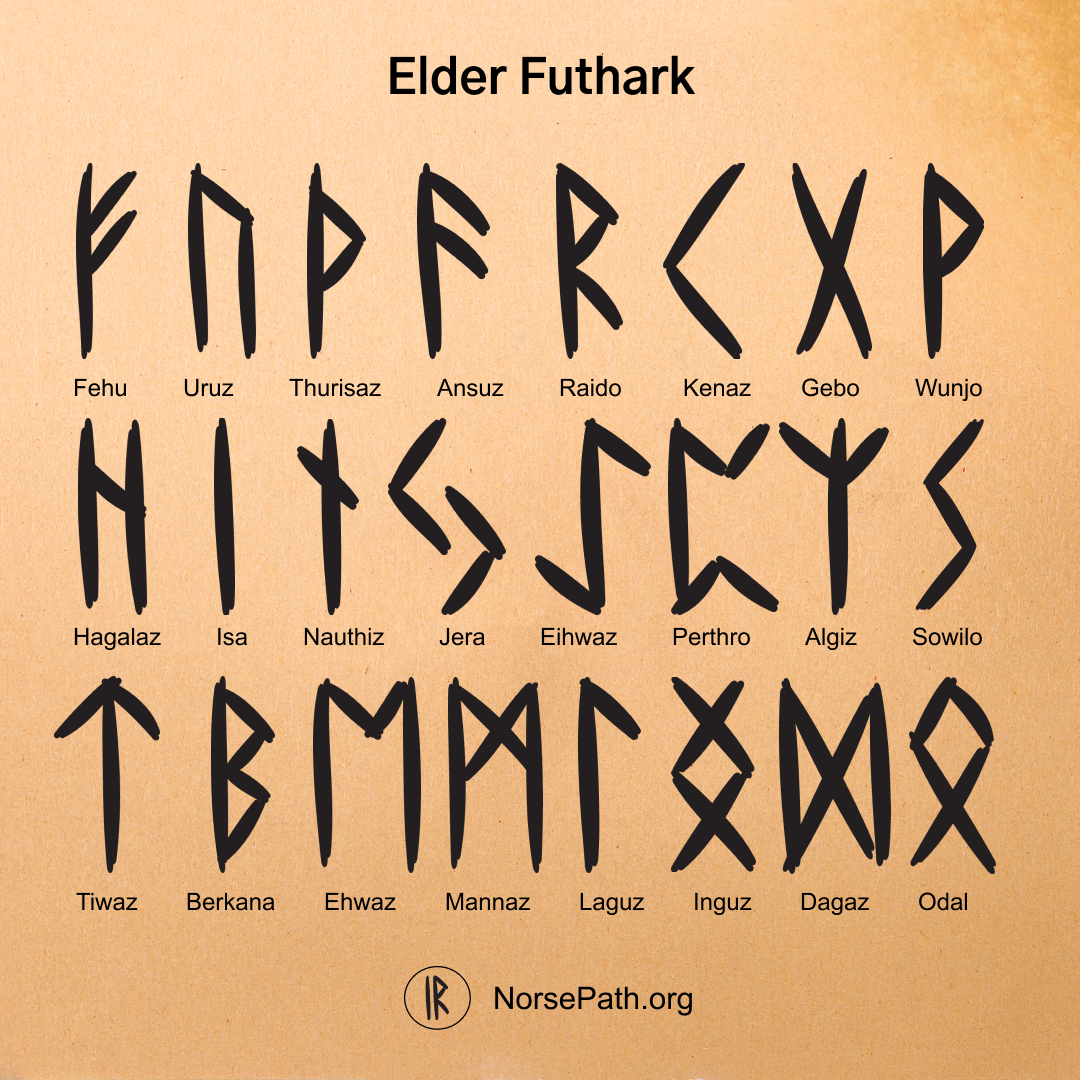
The Futhark is named after its first six runes: F (Fehu), U (Uruz), Th (Thurisaz), A (Ansuz), R (Raidho), and K (Kenaz). It was organized into three distinct groups of eight runes each, known as an ætt (plural ættir), or family. Each ætt is thought to have been presided over by a specific deity: the first by Freyr and Freyja, gods of fertility and prosperity; the second by Heimdallr, the ever-watchful guardian of the Bifröst bridge; and the third by Týr, the one-handed god of justice and war. This structure alone suggests a divine order, a way of organizing reality through the lens of the gods themselves.
But the true power lay in the meaning of the individual runes. Each symbol had a name that carried a potent conceptual weight. Fehu, the first rune, meant ‘cattle’ but symbolized wealth, abundance, and mobile power. To carve Fehu was not just to write ‘F’; it was to invoke the energy of prosperity. Uruz, ‘aurochs’ (a wild ox), represented untamed strength, vitality, and primal creative force. Thurisaz, ‘thorn’ or ‘giant’, was a symbol of chaos and destructive power, but also of protection and resistance. Ansuz was the rune of Odin himself, representing divine breath, communication, and inspiration. To write with runes was to assemble these cosmic concepts. A name carved on a sword was not just an identifier; it was a binding of specific energies—strength, victory, protection—to the wielder. This is why the role of the Rúnemester, or Rune Master, was so vital. This individual was more than a scribe; they were a philosopher, a magician, and a conduit to the divine, capable of interpreting and wielding the potent language that governed their world. They understood that the Futhark was not just for writing sagas, but for shaping them.
Carving fate: runes in magic, ritual, and divination
For the people of the North, fate—or Ørlög—was not a distant, abstract concept. It was an active, ever-present force, woven by the Norns at the base of Yggdrasil. While Ørlög was mighty, it was not entirely immutable. Through the right rituals and the use of the runes, one could understand their fate, navigate it, and perhaps even influence it. Runes were the primary tool for this sacred conversation with the cosmos.

One of the most direct ways to ‘speak’ with the divine was through runic divination. Historical accounts, such as those by the Roman historian Tacitus describing the practices of Germanic tribes, speak of a common method. A Rune Master would take small pieces of wood—often from a fruit-bearing tree—inscribe them with runes, and cast them onto a white cloth. Gazing at the heavens, they would then pick three pieces at random. The interpretation of these runes, their meanings, whether they were upright or reversed, and their relationship to each other, would provide insight into the will of the gods and the likely outcome of a situation. It was a direct appeal for guidance, a way of reading the patterns of fate as they were unfolding.
Beyond divination, runes were the cornerstone of Norse magic, often referred to as Galdr (incantations) or Seidr. They were not merely predictive but prescriptive. Runes could be carved to actively shape reality. A warrior might carve Tiwaz, the rune of the god Týr, onto the hilt of his sword or the face of his shield, invoking the god’s spirit of victory and sacrifice in the coming battle. The Algiz rune, a symbol of protection resembling a splayed hand or the antlers of an elk, was a powerful ward against evil, often inscribed on amulets or over the doorways of homes. In Egil’s Saga, the warrior-poet Egil Skallagrímsson uses his runic knowledge to expose a poisoned drink. He carves runes onto the drinking horn and stains them with his own blood, causing the horn to shatter and revealing the treachery. This is a perfect example of runes being used as an active agent, a force that interacts with and reveals the hidden truths of the world. From healing spells to curses, from blessing a ship for a safe voyage to ensuring a good harvest, runes were the practical application of divine will in the mortal realm. They were the threads with which a Viking could attempt to weave their own destiny into the grand tapestry of the Norns.

 History Warrior Team


