
The heart of the beast: Selecting the right timber
The silhouette of a Viking longship against a misty fjord is one of history’s most powerful images. It speaks of adventure, conquest, and unparalleled craftsmanship. These were not just boats; they were the very vessels that powered the Viking Age, carrying warriors, traders, and settlers across treacherous seas. But how was such a masterpiece of naval engineering created with the tools of the early medieval period? The journey begins not in a shipyard, but deep within the ancient forests of Scandinavia. The soul of a longship is, and always will be, the wood it is born from.

The Norse shipwrights were masters of their environment, possessing an intimate knowledge of timber that we can only marvel at today. Their primary choice for a longship’s hull was oak. Strong, dense, and incredibly resistant to the rot of the saltwater, oak was the undisputed king of the forest. But not just any oak would do. The shipbuilders sought tall, straight trees, often hundreds of years old, with a grain that was perfect for the unique construction method they employed. This was a sacred and crucial first step; the quality of the timber would directly determine the strength and longevity of the finished vessel.
The genius of Viking ship construction lies in the clinker-built, or lapstrake, technique. Unlike later European ships built with a rigid internal skeleton first, the Vikings built the skin of the hull first. They would split, not saw, massive oak logs into long, wedge-shaped planks. This process, known as riving, follows the natural grain of the wood. It is a far more laborious process than sawing, but it produces planks that are significantly stronger and more flexible, as the wood’s natural fibers remain intact. Each plank, or ‘strake’, would overlap the one below it, creating a distinctive and incredibly resilient hull that could flex and twist with the motion of the waves, rather than fighting against them.
Modern replica projects, like the famed ‘Sea Stallion from Glendalough’, have shown just how demanding this first step is. Sourcing enough high-quality, straight-grained oak is a monumental challenge. Builders must often search far and wide for the perfect trees, understanding that a single compromise in the wood could compromise the entire project. While the keel and hull strakes were almost exclusively oak, other woods played vital roles. Tall, straight-grained pine or fir was preferred for the mast, prized for its height and slight flexibility. Ash, yew, or other hardwoods might be used for oars, tillers, and other smaller components, each selected for its specific properties. This meticulous selection process shows that a longship wasn’t merely assembled; it was orchestrated, with each piece of wood chosen to play its part in the grand symphony of the sea dragon.
From keel to clinker: The art of construction
With the timber selected and painstakingly prepared, the physical construction of the longship could begin. The entire process was a masterclass in precision, strength, and community effort, often taking place on an open shoreline. The foundation of it all was the keel. This was the ship’s backbone, often carved from a single, massive piece of oak. It was T-shaped, providing a stable base to which the first planks, the garboard strakes, would be attached. The graceful, sweeping lines of the finished longship were determined right here, in the shaping of the keel and the stem and stern posts that rose from its ends.
Next came the slow, methodical process of raising the hull, one strake at a time. Each riven plank was hand-shaped with axes and adzes to fit perfectly against the one below it. This was not a simple stacking of wood. Each plank had to be steamed or carefully heated over a fire to become pliable, allowing the shipwrights to bend and twist it into the desired curve. Once a strake was in place, overlapping its predecessor by a few inches, it was time to bind them together. This is where another key piece of Viking technology came into play: the iron rivet.
Holes were drilled through both overlapping planks, and an iron rivet was pushed through from the outside. On the inside, a small, square iron washer, or ‘rove’, was placed over the end of the rivet. One shipwright would hold a heavy hammer against the rivet head on the outside of the hull, while another, on the inside, would hammer the end of the rivet over the rove, clenching it tight. This created a remarkably strong and surprisingly watertight bond. Multiplying this process by thousands of rivets, the shipwrights created a light, flexible, and incredibly tough hull. The rhythmic ‘clang’ of hammers on iron would have been the heartbeat of the shipyard.
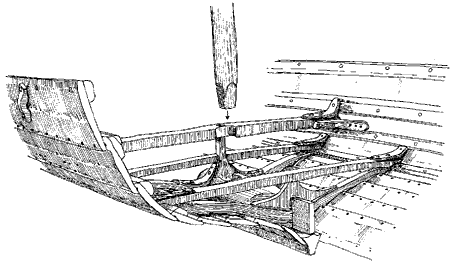
One of the most surprising aspects of Norse shipbuilding, especially to modern eyes, is that the internal frames were installed *after* the hull shell was largely complete. These ribs, or ‘spanter’, were not rigidly nailed to the strakes. Instead, the builders would leave raised ‘cleats’ on the inner surface of the oak planks during the carving process. The ribs were then laid against these cleats and lashed into place, often using tough, pliable spruce or fir roots. This ingenious method allowed the hull to maintain its critical flexibility. When a powerful wave struck, the entire ship could twist and absorb the impact, distributing the stress across the whole structure rather than concentrating it on a single rigid point. It was this blend of brute strength and engineered flexibility that made the longship the ultimate seaworthy vessel of its day.
The finishing touches: Rigging, carving, and sealing
With the hull complete, a skeletal dragon lay on the shore. Now, it was time to give it a soul and prepare it for the sea. A crucial step was stepping the mast. A massive block of oak, known as the ‘kerling’ or ‘mast fish’, was set into the keel and ribs at the center of the ship to provide a solid base. The tall pine mast was then hoisted into place, a moment of great significance for the community. The mast was held in place by a clever system of rigging but was designed to be lowered quickly. This allowed the Vikings to go from full sail to oar power rapidly, enabling them to launch surprise raids or navigate shallow rivers far from the coast.

The engine of the longship was its single, massive square sail. These sails were monumental undertakings in themselves, woven from coarse wool. The natural lanolin in the wool provided a good degree of water resistance, but they were often treated with animal fats or tar to improve their performance. Weaving a sail large enough for an ocean-going longship required the fleece of hundreds of sheep and was a task that fell to the women of the community. Historical accounts and tapestries suggest these sails were often dyed, perhaps in bold red stripes, making them a fearsome and unmistakable sight on the horizon.
Direction was controlled not by a central rudder, but by a large steering oar, or ‘steer-board’, mounted on the right side of the stern. This is the origin of the nautical term ‘starboard’. This side-mounted rudder provided excellent control and could be raised in shallow water to prevent it from being damaged. Finally, no longship was complete without its iconic prow. The fearsome dragon or serpent head that gave the ‘drakkar’ ships their name was more than just decoration. It was an instrument of psychological warfare, designed to strike fear into the hearts of enemies. These elaborate carvings were also deeply symbolic, believed to ward off evil spirits at sea. Interestingly, these figureheads were often removable. When returning to friendly shores in Iceland or Norway, the Vikings would remove the heads so as not to frighten the ‘landvættir’, the protective spirits of the land.
The final, vital task was to make the ship watertight. The small gaps between the clinker-built planks were caulked with a mixture of tar and animal hair or wool. This mixture was painstakingly forced into every seam of the hull. It was a smelly, messy job, but absolutely essential for the safety of the crew. This tarring and caulking would be a continuous process of maintenance throughout the ship’s life. With the last seam sealed and the dragon head fixed in place, the longship was ready. It was no longer a collection of wood and iron, but a living entity, ready to carry its crew to fame, fortune, or Valhalla.

 vikings


