
The echo of the thunder god in Viking steel
Close your eyes and listen. Can you hear it? Beyond the crash of waves against a longship’s hull and the cries of gulls on the wind, there is another sound. It’s the rumble of a distant storm, the promise of lightning on the horizon. For the Norse people, this was not just weather; it was the sound of their protector, the thunder god, Thor, riding his chariot across the heavens. But Thor’s presence wasn’t confined to the stormy skies. His essence—his unyielding strength, his protective fury, and his righteous power—was drawn down from the heavens and hammered into the very heart of the Viking world: their steel.
The story of Viking weaponry is not merely a tale of metallurgy and warfare. It is a saga of belief, a testament to a culture that saw the divine in the tangible. The bloodline of Thor is not one of flesh, but of spirit and steel. It flows not through veins, but through the pattern-welded fuller of a sword and the crescent edge of a battle axe. Join us as we journey into the heart of the Norse forge, where mythology was not just told, but hammered into existence, and the strength of a god became a warrior’s trusted companion.
Mjölnir: more than a hammer, a divine blueprint
At the very center of this divine legacy stands the most legendary weapon in all of Norse mythology: Mjölnir. To understand the Viking warrior’s connection to their own weapons, we must first understand the hammer that set the standard. Mjölnir was the divine blueprint for all earthly strength, an artifact whose creation story is as dramatic as its power.
According to the sagas, the hammer was born of trickery and unparalleled craftsmanship. The mischievous god Loki, having shorn the golden hair of Thor’s wife, Sif, was forced to procure replacements from the dwarves. In a boastful wager with the dwarf brothers Brokkr and Eitri, Loki staked his own head on their inability to create treasures greater than those of their rivals. While being pestered by a fly (Loki in disguise), the brothers toiled at their forge. They produced the golden-bristled boar Gullinbursti and the golden ring Draupnir, but their final creation was their masterpiece. Despite the bellows being disturbed at a critical moment, resulting in a short handle, they pulled Mjölnir from the fire—a hammer of such perfect balance and immense power that it would never miss its mark and would always return to its master’s hand.
Mjölnir’s symbolism was profoundly dualistic. In Thor’s grasp, it was a weapon of pure annihilation, the bane of the jötnar (giants) who threatened the order of the cosmos. Its swing was the thunderclap, its impact the lightning strike. Yet, this same instrument of destruction was also a tool of blessing and consecration. Thor used Mjölnir to hallow, to sanctify, and to protect. It was raised to bless marriages, sanctify funeral pyres, and protect the boundaries of Midgard, the realm of mortals. This duality is key: it was both a shield and a sword, a creator and a destroyer. It is this very essence that Viking warriors sought to capture in their own arms and armor.
Forging thunder: the Viking blacksmith’s sacred art
If Mjölnir was the divine blueprint, the Viking blacksmith was the mortal architect tasked with recreating its power on earth. In Norse society, a skilled smith was a figure of immense respect and even awe, often seen as a master of mystical arts. They were not just laborers; they were alchemists who could transform brittle iron ore into life-or-death instruments. The forge was their temple, a place of elemental fury where earth, fire, and water were bent to their will.
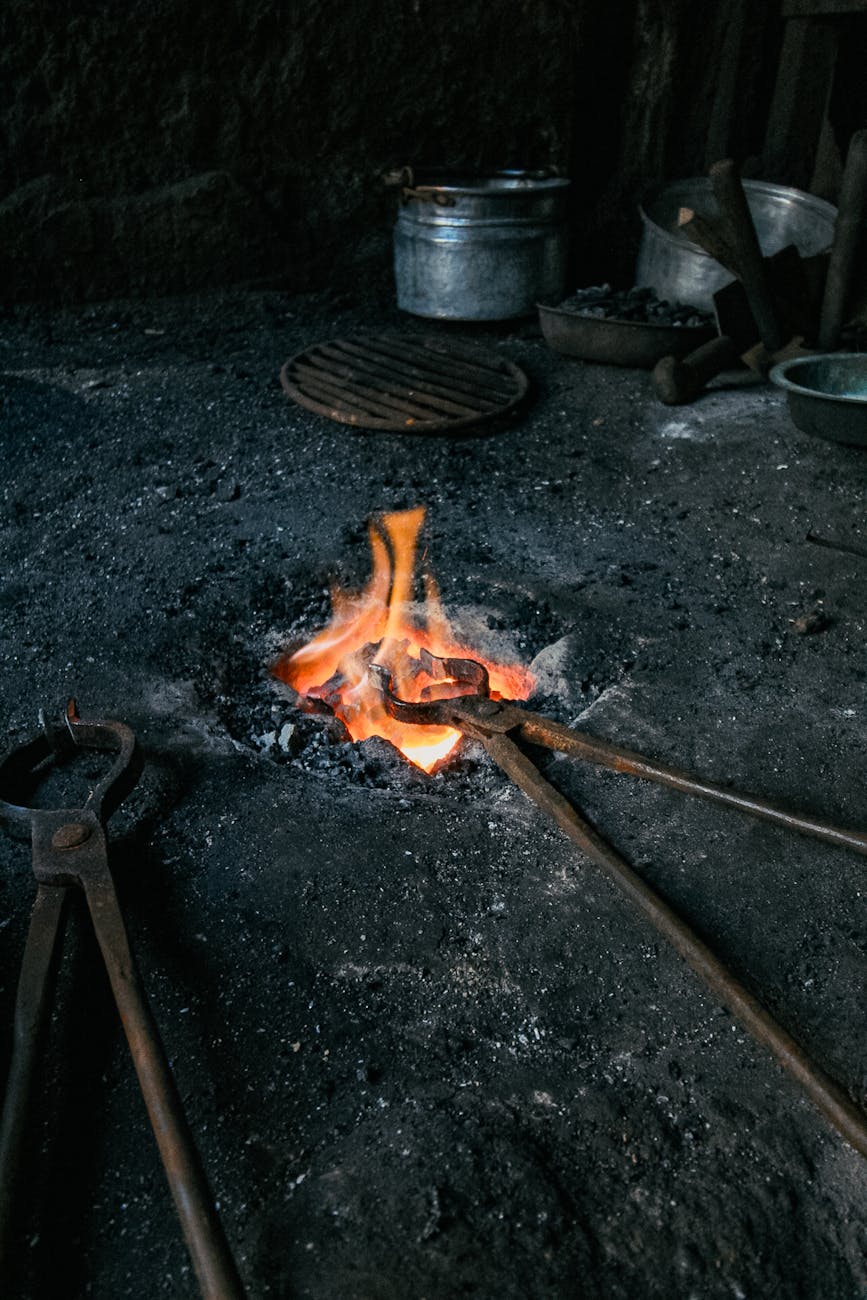
The rhythmic, deafening clang of the hammer on the anvil was a terrestrial echo of Thor’s thunder. The hiss of red-hot steel plunged into the quenching trough was the sound of a serpent’s dying breath. This was a sacred and violent process. The smiths who mastered techniques like pattern-welding were, in a sense, weaving sagas in steel. This complex process involved twisting and forging together rods of iron and steel with different properties, creating blades that were both hard-edged and flexible. The resulting shimmering, serpentine patterns on the blade’s surface were not just beautiful; they were a visible testament to the weapon’s inner strength, a woven lineage of power.
These smiths understood that they were not merely making tools. They were creating companions for warriors, extensions of their will that had to be trusted with their very lives. It is no surprise, then, that this process was likely steeped in ritual, a channeling of divine energy into the metal itself.
The bloodline of weapons: Thor’s spirit in the Viking arsenal
While no mortal could wield Mjölnir, its spirit was diversified across the entire Viking arsenal. Each weapon, in its own way, carried a piece of Thor’s power, adapted for the hands of men and women who fought to protect their homes and carve their names into history.
The Viking axe: a common man’s thunder
If the sword was the weapon of the jarl, the axe was the soul of the common Viking. It was a tool of the farmstead and the forest, easily transformed into an instrument of war. Its brutal, cleaving power was a direct reflection of Thor’s straightforward might. A single, well-aimed swing could split a shield, a helmet, and the warrior beneath. There was no finesse, only devastating force—a lightning strike in the hands of a mortal. The bearded axe, with its elongated lower edge, provided a hook to pull away an enemy’s shield, leaving them vulnerable to a final, thunderous blow. It was a democratic weapon, accessible and effective, embodying Thor’s role as a champion of the common folk.
The legendary sword: weaving sagas in steel
The Viking sword was more than a weapon; it was a legacy. Often passed down through generations, it was a physical bloodline, accumulating the stories and spirits of its wielders. Swords were given names—like *Leg-biter* or *Peace-wrecker*—granting them a personality and a destiny of their own, much like Mjölnir. The most revered of these were the Ulfberht swords, a near-mythical class of weapon from the Viking Age. Made of high-carbon crucible steel, their quality was so far beyond the norm that for centuries, historians believed they must have been imported from the East. Their purity and strength were so exceptional that they seemed to be divinely inspired, forged not just with fire, but with a spark of Asgardian magic. To hold such a sword was to hold a piece of your lineage, an heirloom imbued with the protective strength of the gods.
The shield and helm: Thor’s protective embrace
Thor was not only a god of war; he was, first and foremost, the great protector of Midgard. This protective aspect was just as crucial to the Viking warrior as offensive might. The shield and helmet were the most direct manifestations of this principle. The round shield, often painted with symbols and runes, was not a passive piece of equipment. It was an active barrier against the chaos of battle, a portable fortress. The helmet, most famously represented by the Gjermundbu find, was the ultimate guardian of the mind and senses. Inscribing these items with runes or invoking Thor’s name before a battle transformed them from simple pieces of wood and iron into sacred talismans, a tangible prayer for the god’s protective embrace amidst the storm of steel.
Runes and rituals: consecrating steel with sacred power
The physical properties of steel were only half of a weapon’s power. To truly awaken its spirit, it needed to be consecrated with the language of the gods: the runes. The act of carving runes into a sword’s hilt, an axe’s haft, or a spear’s tip was a profound magical act. It was believed to imbue the object with specific powers, turning it into a conduit for cosmic forces.
Runes like ᚦ, *Thurisaz*, were directly associated with Thor and the giants, representing a force of directed, destructive power or defense. The rune ᛏ, *Tiwaz*, named for the god Týr, was a common inscription for victory. While not directly linked to Thor, its presence on a weapon signified a warrior’s appeal to all the divine forces that governed battle. These were not mere decorations. They were declarations of intent, requests for divine partnership in the chaos of combat. It is easy to imagine a warrior whispering an invocation over their blade, perhaps smearing it with their own blood to forge a personal bond, calling on Thor to guide their hand and grant their steel the strength to protect their kin.
The archaeological evidence: echoes from the earth
This deep connection between Thor and the tools of war is not just the stuff of sagas. It is written in the very earth of Scandinavia and beyond. Archaeologists have unearthed thousands of Mjölnir pendants, small hammers worn as amulets, from Britain to Russia. These were not just jewelry; they were personal statements of faith and pleas for divine protection, worn by men, women, and children alike. They show how deeply the image of Thor’s hammer was integrated into the daily lives and identity of the Norse people.
Weapon finds further solidify this link. The intricate patterns on Ulfberht swords speak to a near-religious devotion to the craft. The care with which weapons were treated, often buried with their owners to accompany them to the afterlife, shows they were seen as essential parts of a person’s soul. While a sword inscribed with “Thor Hallow This Blade” has not been found, the combination of superior craftsmanship, runic inscriptions, and the overwhelming prevalence of Mjölnir amulets paint a clear picture: the power of the thunder god was a constant and vital presence in the life and death of a Viking warrior.
The enduring legacy of Thor’s steel
The Age of Vikings eventually faded, but the echoes of Thor’s hammer never truly fell silent. The bloodline of Thor, forged in myth and hammered into steel, represents one of the most powerful connections between belief and craftsmanship the world has ever seen. It teaches us that for the Vikings, a weapon was never just an object. It was a promise, a protector, and a vessel for the divine fury of the storm.
From the legendary form of Mjölnir to the humble bearded axe, the spirit of the thunder god was present in every swing and every parry. It was there in the smith’s sacred fire and in the warrior’s final prayer. The bloodline of Thor is not a memory lost to time; it is a legacy of strength, woven into steel, that still resonates with the power of a distant, rolling thunder.

 vikings


