
Forged from the land: the essential materials of Norse attire
Before a single stitch could be laid, before a warrior could don their gear for battle or a farmer their tunic for the fields, the story of Viking clothing began with the earth itself. The garments of the Northmen were not born in sterile workshops but were a direct product of their environment—a testament to their resilience, resourcefulness, and deep connection to the land they called home. To understand their clothing is to first understand the raw materials that gave them shape, color, and strength.
The two undisputed kings of the Viking loom were wool and linen. Wool, harvested from hardy northern sheep breeds like the Spelsau, was the cornerstone of their wardrobe. It was a material perfectly suited for a life lived at the mercy of harsh seasons. The natural lanolin in the fibers made it water-resistant, capable of shedding a light rain or sea spray on a longship journey. More importantly, its insulating properties were unparalleled, trapping body heat to keep a warrior warm during a brutal Scandinavian winter or a night watch in a foreign land. The process was laborious: shearing, cleaning, carding, and finally, spinning the raw fleece into thread using a drop spindle. The quality of the wool, from coarse outer fleece for rugged cloaks to fine inner wool for softer tunics, spoke volumes about the wearer’s status.
Linen, derived from the flax plant, was wool’s essential counterpart. Where wool provided warmth and protection, linen offered comfort and breathability. Cultivating flax was a demanding process, requiring careful planting and a back-breaking harvest where the entire plant was pulled from the root. The stalks were then retted (rotted), broken, and scutched to release the long, soft fibers within, which were spun into a smooth, strong thread. This fabric was used for undergarments like the chemise (serk) or undertunic, worn directly against the skin. It was hygienic, comfortable in warmer weather, and prevented the coarse wool of outer layers from chafing. A fine, bleached-white linen garment was a mark of considerable wealth, as the bleaching process was intensive and time-consuming.
Color was another language spoken through fabric. Forget the drab, brown-clad barbarians of popular myth; the Viking world was a surprisingly colorful one. Dyes were painstakingly extracted from the natural world. Madder root produced a spectrum of reds, from pale pink to a deep, blood-like crimson—a color often favored by chieftains. Weld and other local plants provided vibrant yellows, while woad was the source of coveted blues, a color associated with both royalty and the mystical. The richness and vibrancy of a garment’s color were direct indicators of wealth. A Jarl might wear a cloak of deep red trimmed with imported silk, while a common farmer’s tunic would likely be a more subdued, undyed shade of cream or brown, known as ‘vaðmál’.
Beyond fabric, leather and fur played crucial supporting roles. Leather, tanned from the hides of cattle, deer, and goats, was essential for durable goods. It formed the sturdy shoes (skór) that trod on distant shores, the strong belts that held tools and weapons, and the protective pouches that carried a Viking’s worldly possessions. Fur, from animals like beaver, marten, or even bear, was a luxury item used to trim cloaks, cuffs, and collars, adding another layer of warmth and a powerful statement of a hunter’s prowess and social standing.
Weaving a Viking life: core garments for every warrior and shieldmaiden
With threads of wool and linen ready, the loom became the heart of the Norse household. Viking clothing was fundamentally practical, designed for a life of hard work, long voyages, and sudden combat. Yet, within this practicality lay a distinct and iconic style, a silhouette recognizable across the ages. The core garments were simple in construction but layered and accessorized to create a versatile and expressive wardrobe for both men and women.
For a Viking man, the foundational piece was the ‘kyrtill’, or tunic. This garment, typically made of wool, was the workhorse of his attire. It was usually cut with a simple T-shape, often incorporating triangular gores in the sides and underarms to allow for greater freedom of movement—essential for swinging an axe or rowing an oar. The length varied, commonly falling to the mid-thigh or knee. A common man might wear a single, durable tunic, while a wealthier individual would layer a linen undertunic beneath a finer wool kyrtill, perhaps decorated with woven braid at the collar and cuffs. The tunic was a canvas for status, with richer colors and finer weaves signaling a man of importance.
Paired with the tunic were trousers. Archaeological finds suggest several styles. Some were simple, straight-legged trousers, not unlike modern pants. Others were more voluminous, known as ‘rus’ pants, which were baggy around the thighs and tapered towards the ankle, often requiring leg wraps (‘winingas’) to be wound from the ankle to the knee for support and protection. These wraps secured the trousers and provided extra warmth, a crucial detail in the cold North. Cinching this all together was a leather belt, a non-negotiable part of the male ensemble. It was not merely for holding up trousers but served as a tool belt from which a man would hang his knife, fire-starting kit, and pouch.
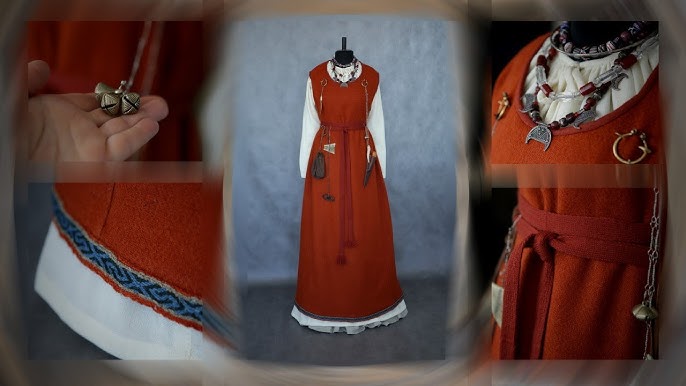
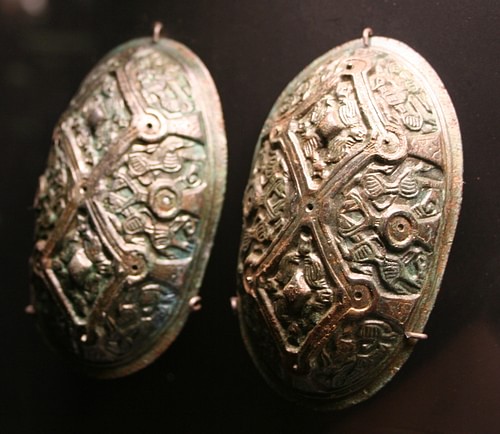
The clothing of a Viking woman was equally functional but distinctively feminine and elegant. Her primary undergarment was the ‘serk’, a long-sleeved underdress made of linen, which could be pleated and often reached the ankles. Worn over this was the most iconic piece of female Viking attire: the ‘hangerok’, or apron dress. This was a tube of fabric, usually wool, that was suspended from the shoulders by two straps. At the front, these straps were fastened to the dress with a pair of large, ornate brooches, most famously the oval-shaped ‘tortoise brooches’. These brooches were not just functional fasteners; they were the centerpiece of a woman’s wealth and identity. A string of glass, amber, or silver beads was often draped between them, and from one brooch, she might hang essential tools like a small knife, keys, or a needle case. The hangerok was a symbol of her status as the manager of the household, literally carrying the keys to the farm’s wealth upon her person.
Both men and women relied on the cloak, or ‘félagi’, for protection from the elements. This was typically a large rectangle of thick, heavy wool, which could be worn over the shoulders and fastened at one side with a single, large brooch, known as a penannular or trefoil brooch. The cloak was a multi-purpose garment: a blanket on a cold night, a shield against the rain, and a powerful symbol of status. The quality of the wool, the richness of the dye, and the intricacy of the brooch that secured it all spoke of the owner’s place in the world.
The saga in the stitches: embellishment and personal glory
A Viking garment was never truly complete when it left the loom. The final, and perhaps most important, stage in its creation was embellishment. This was where a simple tunic or dress was transformed into a personal statement, a reflection of one’s family, achievements, and connection to the gods. Through intricate embroidery, woven bands, and gleaming jewelry, the Norse people literally wore their stories, turning their clothing into garments of glory.
Embroidery was a highly valued skill. Using threads of colored wool, silk, or even silver and gold, artisans would adorn the cuffs, collars, and hems of tunics and dresses. The patterns were not random decorations; they were rooted in the powerful visual language of Norse art. Intricate knotwork, swirling beasts from the Jelling or Borre art styles, and geometric patterns were meticulously stitched, adding a layer of protective symbolism and breathtaking beauty. The famous Mammen-style embroidery found in a 10th-century Danish grave chamber showcases a level of artistry that rivals any other culture of the period, with stylized animals and acanthus leaves flowing across the fabric.
Another common form of decoration was tablet-woven braid. This ancient technique produced strong, decorative, and often complex patterned bands. These braids were used to trim the edges of garments, reinforcing them while adding a vibrant splash of color and design. For a warrior, a tunic trimmed with a finely-wrought band was not just a sign of wealth but a piece of armor for the soul, its intertwining patterns perhaps seen as a ward against ill fortune.
Jewelry was the ultimate expression of power and prestige, and it was seamlessly integrated into the clothing itself. As we’ve seen, brooches were essential fasteners, but they were far more than that. The paired tortoise brooches on a woman’s hangerok were often family heirlooms, passed down through generations. A man’s cloak pin, whether a simple iron ring or an elaborate silver trefoil brooch, was a prominent display of his social standing. These pieces, cast in bronze or precious metals and decorated with filigree and granulation, were markers of a life of successful trade or victorious raiding.
For those of us today looking to connect with this rich heritage, the path lies in embracing these same principles. Creating your own Viking garment is not just about sewing pieces of fabric together; it’s about making choices that reflect a story. Will you choose the deep red of a chieftain or the earthy brown of a farmer? Will you spend hours embroidering a knotwork beast onto your sleeve or weaving a simple band of color? Start with a foundational piece, like a linen undertunic or a simple wool kyrtill. Focus on the materials—seek out real wool and linen. Then, build upon it. Add a leather belt. Find or craft a simple brooch. Each addition, each stitch, is a step deeper into the past. In a world of mass-produced fashion, a custom Viking creation is a powerful act of connection, a way to weave your own saga into the timeless threads of the North.

 vikings

